
By Henry Harington
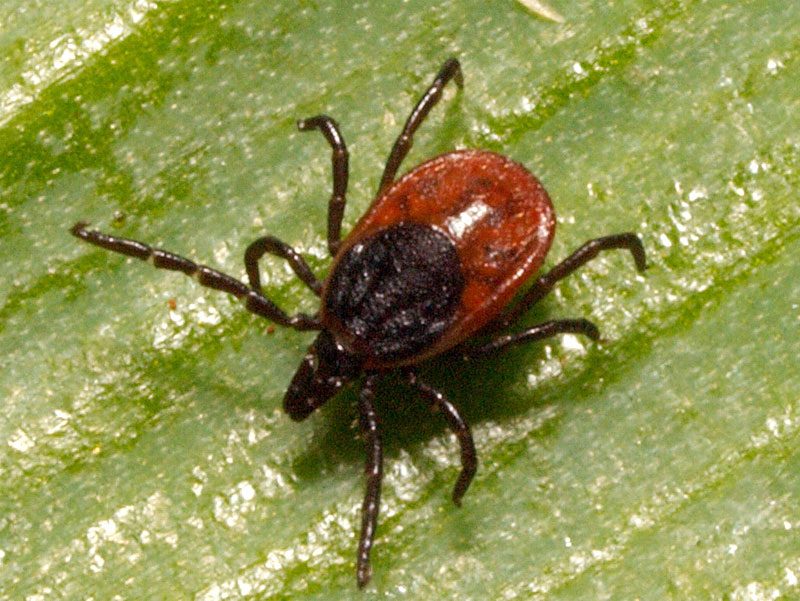
The pestilence of ticks to which people in Luccombe and Exmoor are accustomed could be about to get a whole lot worse. Tick bites are not only a nuisance and raise the risk of debilitating Lyme disease, there is a new risk that they may make people allergic to eating meat.
Many of us are plagued by ticks attaching themselves to our dogs and to our bodies after walking in an around Luccombe. Many will have seen the recent BBC Countryfile programme with coverage from Exmoor that also happened to have an investigation into the scourge of ticks.
I contacted Professor Matthew Baylis of Liverpool University who mentioned in the programme that his department was mapping the incidence of ticks in the UK. I asked him whether there was a map available for Exmoor.
Professor Baylis replied that the mapping was being drafted by a PhD student and that when it was completed he would ask the student to provide the information to me. In the meantime, he sent me the map from Public Health England that shows the incidence of the Ixodes ricinus tick, that is the carrier and infects humans with Lyme disease is particularly prevalent on Exmoor.
By coincidence I read an article in the New York Times that has even more disturbing implications. It had been shown that when a type of tick, the lone star tick, bit humans in the South East United States, it could cause an allergic reaction to eating beef, lamb and pork. Other mammals to humans produce complex sugars call alpha-gal. The affected ticks cause an immune reaction in humans to the alpha-gal found in meats we eat. Sufferers experience a sudden and severe rash and plummeting blood pressure.
When I asked Professor Baylis about the risk in the UK he replied, “ Apes, including humans, lack a certain sugar (called alpha-galactose) that is present in other mammals and so in the red meat that we eat. Bites from some ticks lead to us developing an allergic reaction to alpha-gal, and hence to red meat itself. I’ve read that this has now been identified in several countries, including in Europe, and so I suspect that it is possible in the UK.” He referred to a scientific paper that says that Ioxedes ricinus is implicated in Europe, and added, “Which would imply that this allergy could develop in response to a tick bite in the UK.”
The advice to protect against tick bites starts with avoiding areas like Exmoor – that is impractical for people who live here! But other steps include wearing light clothing to spot ticks that have hitched a ride, wear long trousers tucked into your boots and checking yourself and your dogs when you have been for a walk.
This article may be re-used freely provided acknowledgement is given to the author, Henry Harington, and the Luccombe.org website.
Leave A Comment