As May 8th 2020 marks the 75th anniversary of VE day, Eric thought that a picture of the month with a wartime theme might be appropriate, with a ‘sting in the tail’ to end with! He writes:
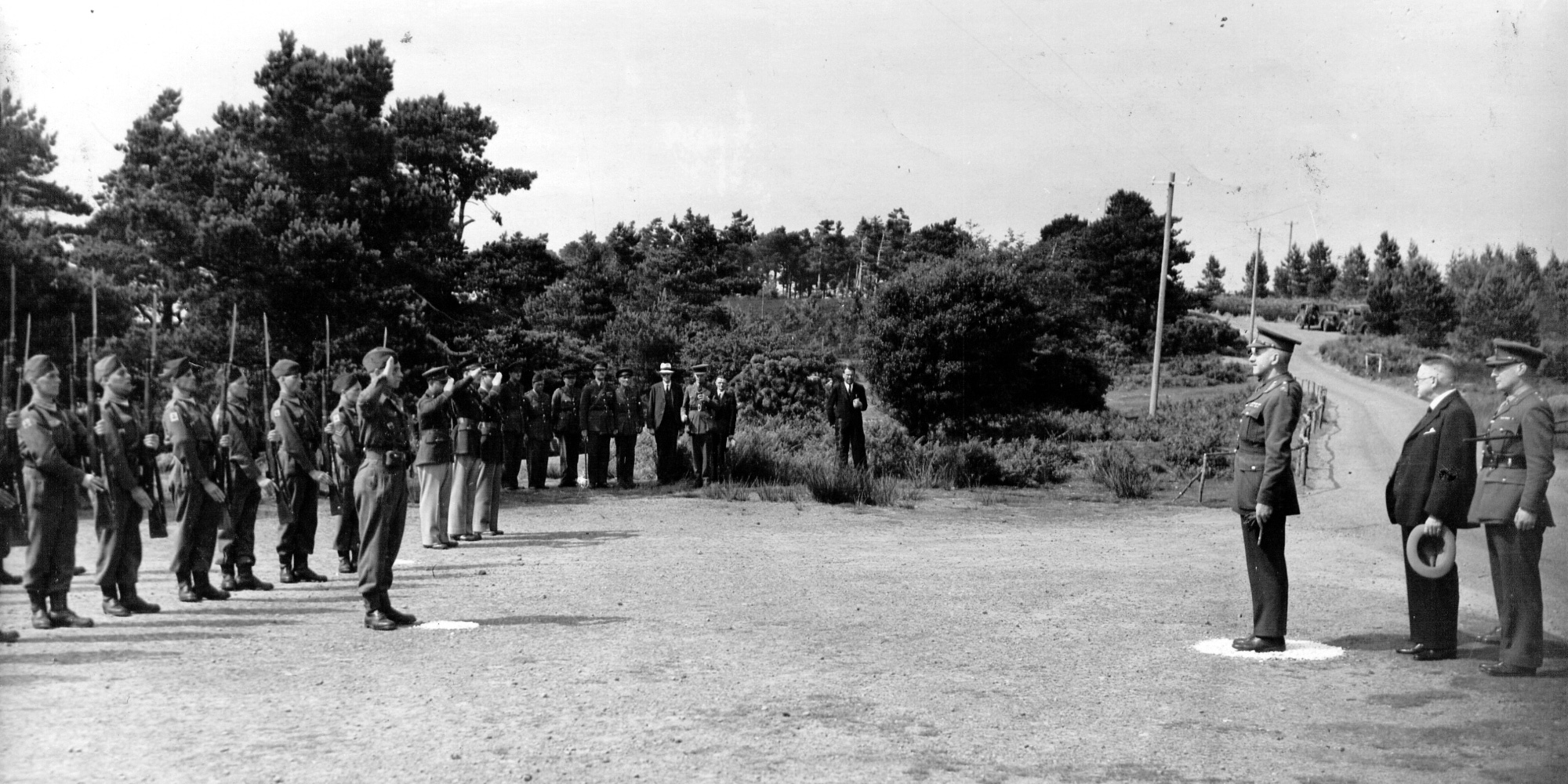
During the Second World War, there was a great deal of military activity on Exmoor. The closest to Luccombe was at Webbers Post where there was a searchlight and anti-aircraft gun emplacement. The first image dates from 1942 and on the back of the original is written- “1942. Presentation of items of furniture to AA gun crews Exmoor at Webbers Post by an American (between the 2 soldiers at the saluting base). Centre (white hat) Cllr WE Dewar, Chairman Minehead UDC. On his 2nd left, Mr AG Mansfield, Clerk of Minehead UDC.”

The second image is of a contemporary picture postcard that I bought from e-bay. It was definitely taken at Webbers Post and it almost certainly shows the military personnel that were stationed there. I have no names, but the soldiers would often come down to the village for the regular Saturday night dances at “The Hut” (the old village hall) and one of them married a Luccombe girl.
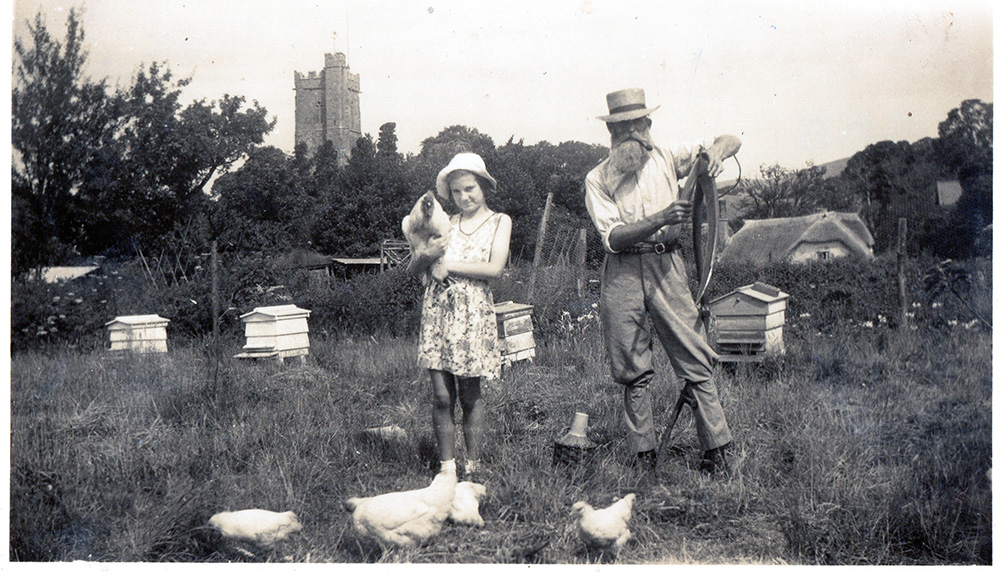
The third picture relates both to the war and the recent planning application for a honey processing venture alongside Chisland Lane. It was taken in the orchard at Wychanger Cottage and shows my father complete with scythe and false beard, together with an evacuee from Bristol, Ann, who was billeted with them during the war. My father’s beehives can be seen in the background. The reason for the false beard and other ultra-rural effects is because the photo was taken by a relative from Bristol, Ted Staddon, who was very keen to capture the old ways of life in his images. My father did say that one of the benefits of wartime bee-keeping was an extra sugar ration and I found the following extract on the internet:
“In 1943, the Ministry of Food announced that beekeepers qualified for supplies of sugar not exceeding 10lbs per colony to keep their beehives going through the winter, and 5lbs for spring feeding.
“When it was suspected that most of the sugar wasn’t reaching the bees because crops of honey were so small, someone had the bright idea of colouring the sugar green to prevent it getting onto the black market. This was soon stopped when the bees started to produce green honey!”
Co-incidentally, the location for the proposed honey processing activity is only a very short distance from where a great friend of my father, Arthur “Chum” Kingdom, the Holnicote Estate thatcher who lived at Allerford, kept his beehives. I can remember watching him working at his hives there during family walks when I was a child.
See our previous pictures of the month and other posts about local history here.
As I mentioned the old Village Hall, (“The Hut”), in the above article, I thought that I had better add the following information that I was only prompted to remember today.
From the West Somerset Free Press 100 years ago – May 1st 1920. “Luccombe’s new parish hall, a former Army hut, was opened. It was the gift of Mr and Mrs J P Lawrence, of Wychanger, and would accommodate 200 people. Among the speakers was the new rector, Dr Purvis. The Allerford Glee and Dramatic Party gave a concert.”.
For those that do not know, it stood in the area beside the Telephone Kiosk, where the seats and picnic bench are now located.
Part of it still remains in the village, my garage used the planking from the floor to make its walls. It was, I was told, an excellent dance floor, having two layers. What a contrast in the village between May 1st 1920 and May 1st 2020!
Dovery Manor Museum is celebrating VE day on its website: https://doverymanormuseum.org.uk/ from 8th May. There will be a brief mention of all those in the Porlock Vale parishes, (including the four from Luccombe) who fell, and much more interesting information.
In 1940/41, 8th Corps Vehicle Maintenance School was in Minehead; their workshops were sited wherein Butlins are now located. My dad was a Sergeant Instructor there after returning from Dunkirk and he secured accommodation for my mother and self to be with him. I went to school there and feel guilty now at feeling so happy and enjoying life at that time when so many other poor folk were suffering such misery! Sadly the school was eventually closed and my dad was posted to the India/Burma theatre. Happily he survived the war.