
The main image from Eric’s archive this month is taken from an early postcard view, which he has chosen mainly for its seasonal flavour as it features on a vintage Christmas card from his collection:
“The inset picture shows the view looking roughly north, down the road towards the village from the Wootton Courtenay road; with Ketnor on the left and the gable end view of the row of thatched cottages that existed before Glebe and School Cottages were built on the right hand side in the first years of the 20th century.
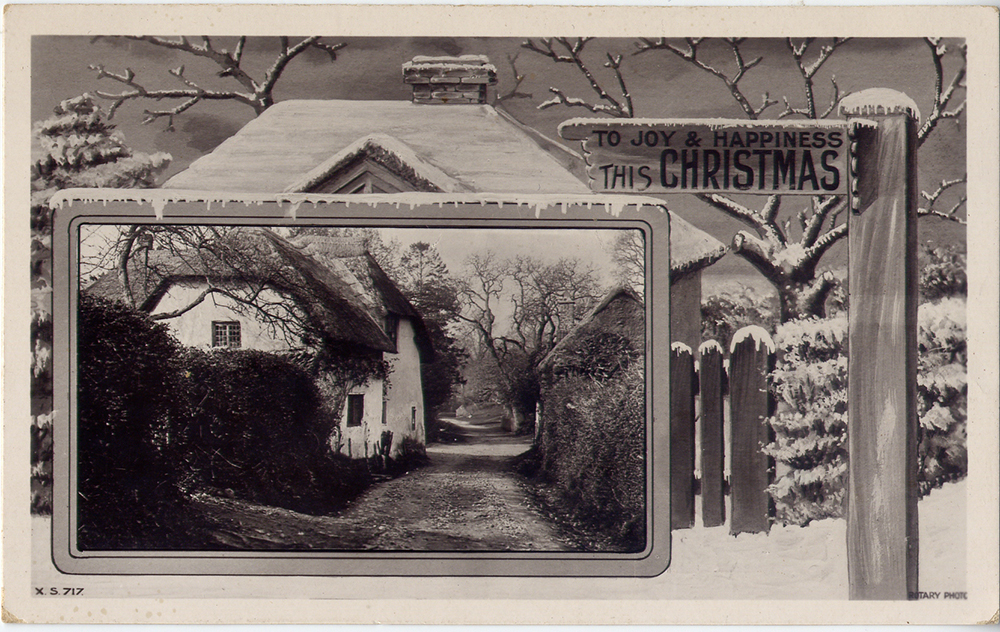
“Probably the most interesting thing about this view is that close inspection reveals a building in the far distance on the right of the road junction. This was the Village Smithy, and the 1841 Tithe Map and its apportionment gave its occupier as one William Culverwell. The 1841 Census shows widower William living in the village with his daughter Lydia age 12, and son Otto, 8. Unfortunately the early census returns are vague regarding specific addresses, so it is not possible to determine whether the family lived on the premises, or, more likely, in a separate dwelling. Still a resident in 1851, by 1861 William was lodging in Stogumber. Otto progressed to become a police sergeant in Oxfordshire.

“I have never seen a detailed view of the Smithy, and I don’t know when it fell into disuse. The back retaining wall still exists, but is now obscured by undergrowth. In the 1950’s the site was cleared and the Coronation Seat was placed there with steps leading up to it, before it was later re-located to its present position on the Green. I can remember Tommy Hale (who lived in what is now Hale’s Cottage) working on preparing the site and making the steps.
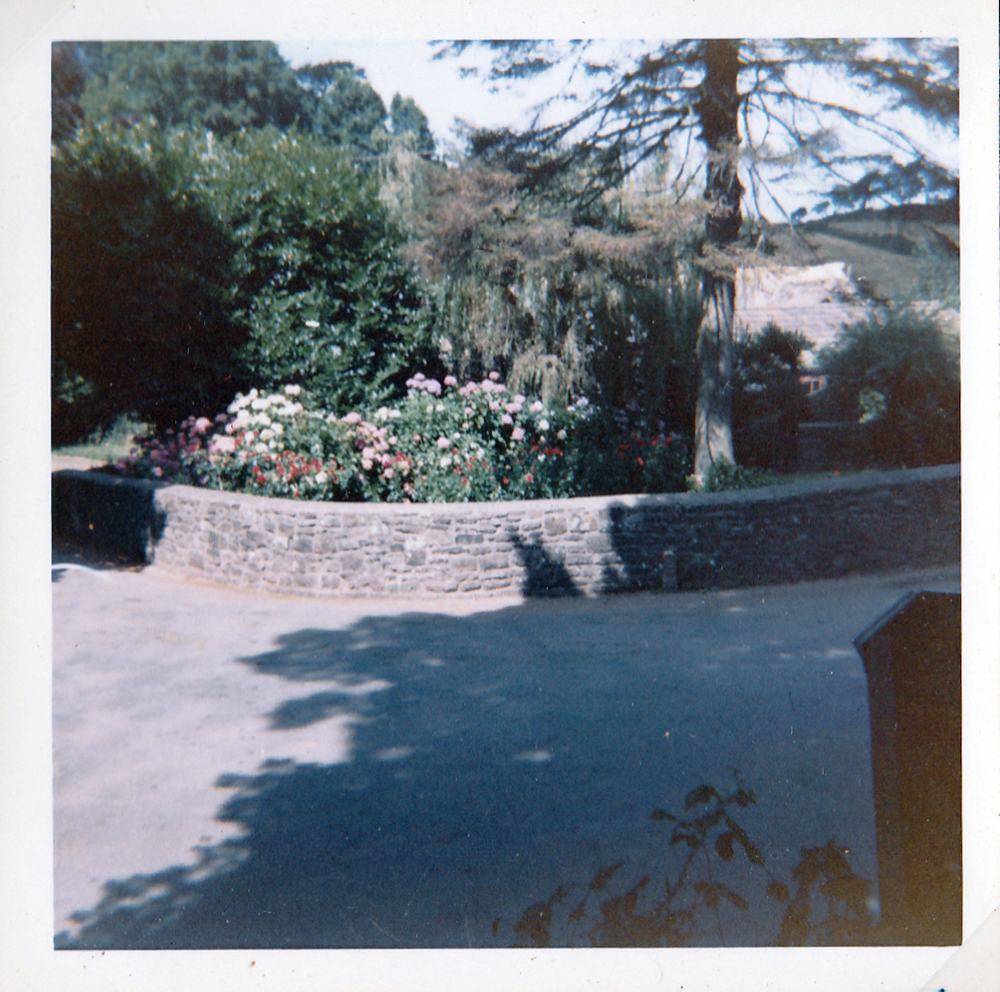
“Now for some real trivia – When Luccombe had a regular bus service (Western National service no. 269 Minehead-Luccombe-Horner Green in the summer and Minehead-Luccombe in the winter), the bus stop consisted of a large board, on to which was pasted the combined timetables for all of West Somerset. For some time the bus stop was located near the site of the Smithy and a small part of it is visible in the bottom right corner of the second photograph showing the garden that the Manvells (formerly at Luccombe Knap) called ‘The Botanical’
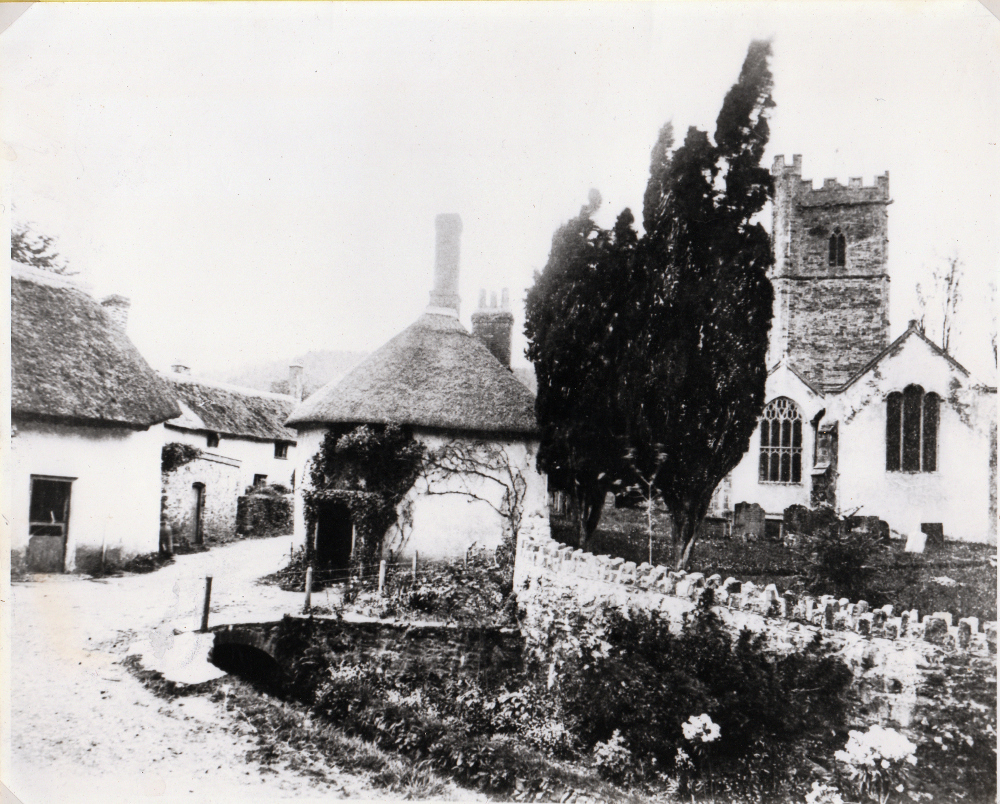
“The final photograph this month follows on from my November item. It gives another view of the house that once stood where ‘Staddons’ was later built.”
Check out all of our previous pictures of the month and read more about Luccombe’s history.
I just wanted to say I love this website of the village with all its news and articles but the best for me is `Erics archive` which I find totally fascinating. Has Eric got any pictures or information concerning the cottages at the top of Stoney Street (Hillgate Cottages). I would love to know any history surrounding them.
Best Regards,
Rich Lovell
1 Hillgate Cottage.
Thank you Rich! I shall ask him for you now 🙂
I was very interested in the reference to the Manvells in the commentary to the picture of the “bus stop”. The Manvells were great friends of my father’s family, and I have just been reading two letters, written from Luccombe Knap in 1947, one from Leslie to my grandfather and the other from Eil to my father.
Hi Cherrill
Eric has written a post about Luccombe Knap, inspired by your comment: https://www.luccombe.org/luccombe-knap-part-one/
I have just found your site! Fascinating. I am particularly interested in Eric’s photo and article about the old Smithy. The story in our family history is that our ancestor was the village blacksmith in 1730’ish. He was apparently a Jacobite rebel who was captured at Eilean Donan Castle in 1719 and deported to Devonport. When he was released he was employed as the blacksmith in Luckham (as it was spelt in those days). To hide his identity he took the name Luckham and later moved to Devon. John MacGhobain is supposed to have married Jane Rowlands in Wootton Courtenay in 1737. However, the relatives that discovered all this have since died and I am trying to verify the story. Apparently when the Smithy was demolished a chest of swords and daggers with Gaellic inscriptions was found buried in the grounds. These are now in the museum at Eilean Donan Castle, donated by my deceased relatives. As a child, in the 1950’s we used to holiday in a caravan on a farm in the village not knowing at that time about the possible connection.
Lovely, thank you Priscilla I’ll pass this on to Eric he may have some information for you 😊
Hello Priscilla.
That is a story that I have not come across before. As the smithy would have been demolished some time around 1890, give or take 10 years, I would have thought that the discovery of the ‘treasure chest’ would have lingered on and been passed down the generations. I have also looked at the transcripts of the Wootton Courtenay parish registers and can find no record of a marriage involving Jane Rowlands and anyone who could have been your blacksmith ancestor. Although I share the same surname as Jane (except my father added the ‘s’, that side of my family came from the Honiton/Colyton area of Devon.
However, nothing is beyond doubt, and if you discover more, I would be very interested to hear.
Perhaps Eilean Donan Castle Museum (I believe there is one) could shed more light.
Incidentally, there is still a blacksmith (now the Forge Studio) at Doverhay in nearby Porlock which was part of Luccombe Parish until it was ceded to Porlock in 1929.
I am still hoping to find one day a decent illustration of Luccombe Smithy.
Good Luck with your research.