By Robin Lewando
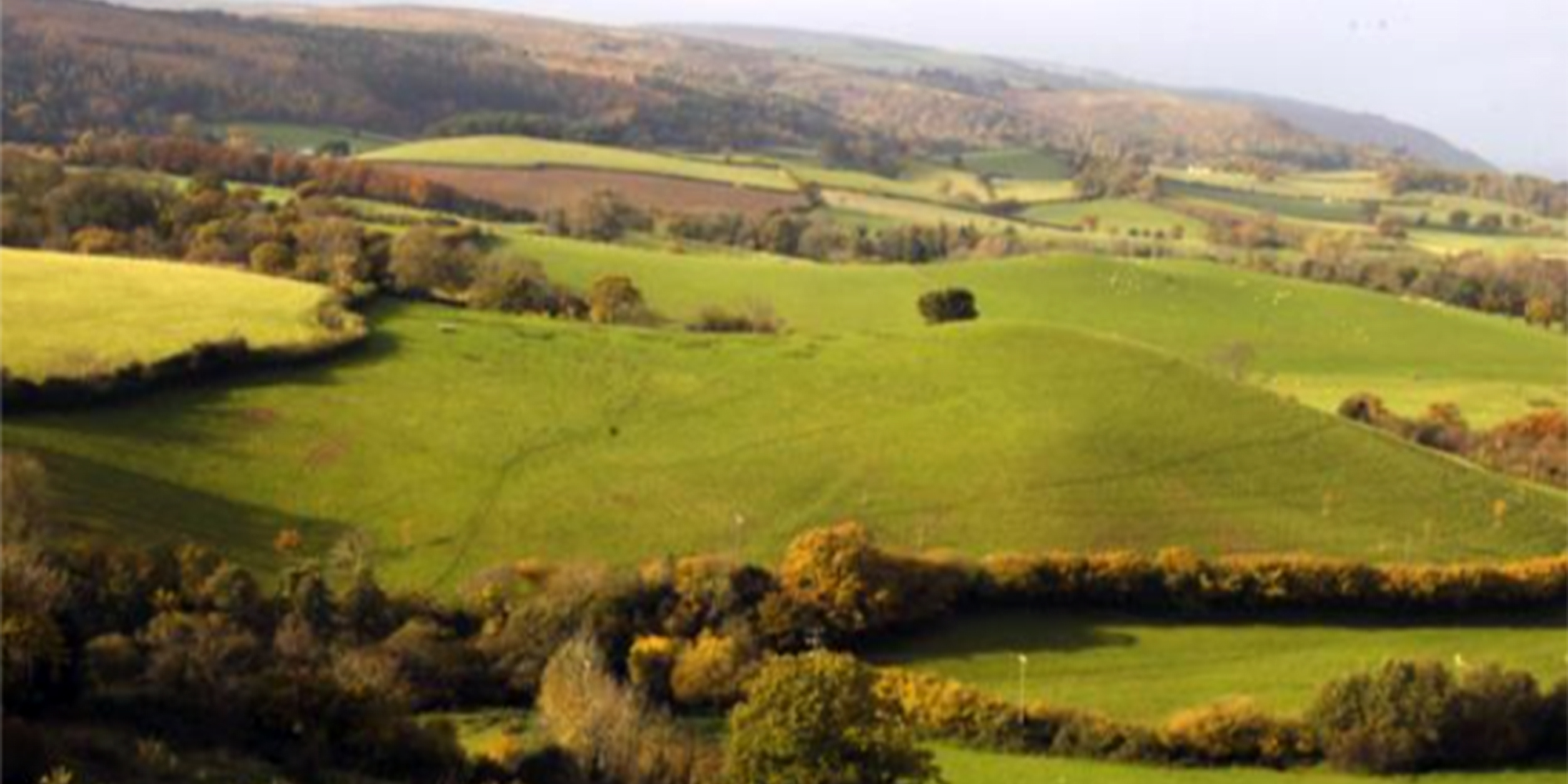
Luccombe has given its name to a rock formation, the Luccombe Breccia, a localised deposit, and one of a series of breccias of a similar age that occur throughout West Somerset and Mid Devon. But what this deposit represents is an environment and an event that stretches our imagination and belief far more than the peaceful, green surroundings would suggest.
Made up from angular fragments broken from the surrounding bare and rocky hills, the Luccombe Breccia was deposited in a desert environment, probably by flash floods, about 250 million years ago, at the beginning of the Triassic period. These breccia deposits were caused by erosion and weathering of the bare, hard, rocky uplands, resulting in scree slopes and fans of talus, sharp and jagged rock fragments, similar to what may be seen in the Atlas Mountains of North Africa today.
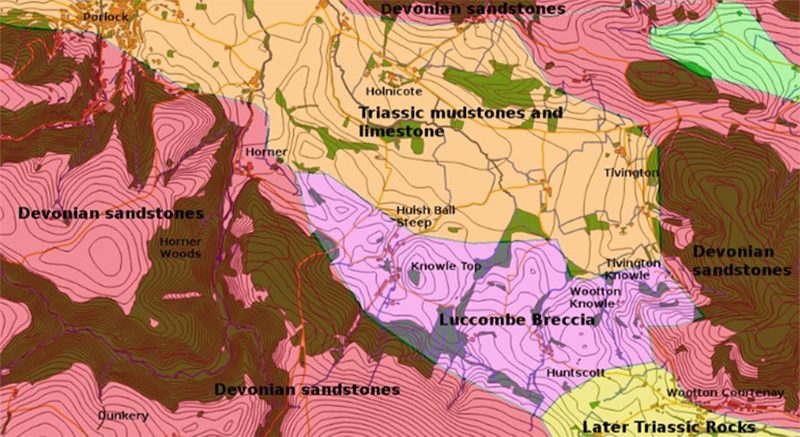
A map of the Southern end of Porlock vale showing the bedrock. This is very diagrammatic, but shows the predominance of Devonian sandstones on the high ground, and the Luccombe breccia. There is quite a lot of faulting within and between these rocks, which is not shown. Map data public domain provided by Ordnance Survey and BGS.
This formation lies below the rocks of Porlock Vale, is as much as 650 m thick, and comprises the distinctive landscape of small hills, known locally as Knowles – Knowle Top, Tivington Knowle, Wootton Knowle. There are three good exposures of Luccombe Breccia – one up Huish Ball Steep, as the lane bends, where it occurs with a boulder bed; another in a deep cut lane going up the hill out of Huntscott where the breccia is interspersed by sandstones; and the third in an old quarry on the path to Luccombe Mill where the breccia can be seen on the west side of the quarry in association with thin seams of sandstone.
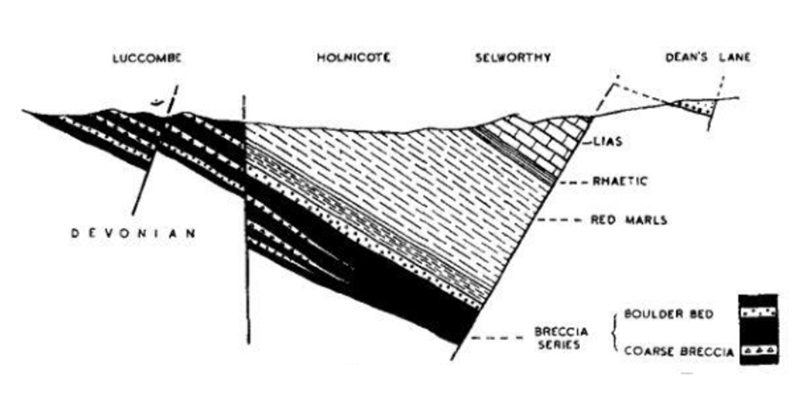
Cross section showing the steeply dipping and faulted Luccombe breccia. Also shown are the various beds within the breccia. Copyright AN Thomas (1940), the Geologists’ Association.
The way to view these deposits is to visualise them as sediments, sand or silt, maybe containing sharp fragments or rounded boulders. It is necessary to remember that most sediment deposits are laid down in a horizontal position, or as in the case of scree slopes, against the side of rock faces and slopes. The most staggering concept is the way that such deposits, once formed into rock, are folded and faulted, squeezed, bent and tipped up, often while at great depth. Faulting is often indicative of movement at lesser depth, folding at greater depth – some of these rocks may have been buried kilometres deep, and consequently may have been at high temperature. The forces, pressures, and temperatures involved are protean, defying imagination and understanding.
The sandstone and boulder beds interspersed with the Luccombe breccia represent periodic changes in deposition, probably as a result of increased wind or water action. Wind action is apparent in the polished and rounded surface of some grains within the deposit, with a staining of iron oxide. Similar sandstones with clear indications of such erosion and deposition processes are to be seen in the Holloway in Minehead, a quite beautiful formation that fully demonstrates the desert environment; and further up the road in the Ball are deposits of breccia.
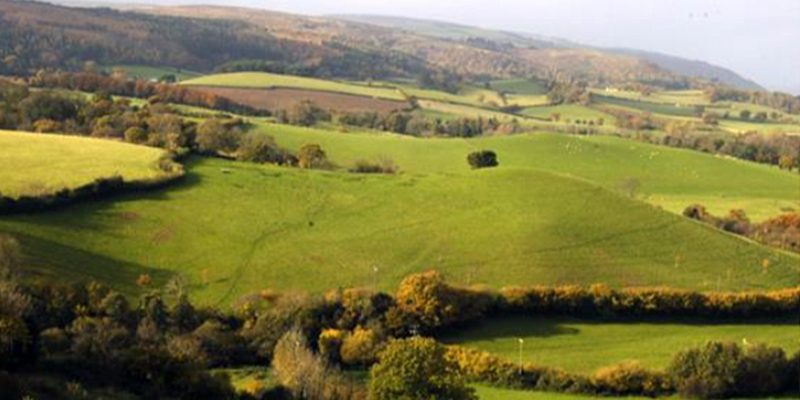
The Knowles: Porlock Vale looking NW, Wootton Knowle in the foreground, Holt Knowle behind, and behind that to the left Knowle Top. Behind that again, and to the right, Huish Ball Steep. There are also two small Knowles behind Huntscott. Tivington Knowle is to the right, out of the picture.
During the Triassic period this part of the earth’s crust was a desert environment in a similar position on the globe as the Sahara is today. But in addition to this harsh environment, the earth had just experienced the most catastrophic extinction in its history, which geologists have used to mark the end of the Permian period. So as our Luccombe Breccia was being deposited in a hot and inhospitable rocky desert, the earth was also severely depleted in life forms. In fact, in many rocks of this early Triassic period, fossil fungal spores predominate, suggestive of the recuperation of living organisms, or the burgeoning of fungal growth on dead and dying organic matter. In a desert environment there are, by definition, fewer life forms to be preserved, and the conditions ideal for preservation are also unlikely to occur. But in addition to this, the severely depleted life on earth at this time makes the finding of fossils of any sort even more unlikely, to say the least.
The extinction event at the end of the Permian period caused the demise of maybe 95% of all life forms, including the large amphibious vertebrates. The cause of the extinction is still discussed, but focus is on extensive volcanic outpourings in Siberia, as much as 3 million cubic kilometres, which caused rapid and extreme global warming with temperatures reaching 35 or even 40 degrees at the equator. The abrupt drop in fossils occurring in rocks of the period in many locations across the earth, make it clear that this was an extreme event of global proportions. The demise of terrestrial plant life to such an extreme resulted in an increase in erosion – which very possibly resulted in our Luccombe breccia being deposited.
In a strange symmetry, the angular fragments in the breccia are broken from the Devonian mud- and sandstones aged 350 million years, deposited in a similar desert environment when this part of the crust was south of the equator. In fact most of the south west of England, and also of Ireland, are comprised of these Devonian sand- and mud-stones, which reach depths of as much as 5 km. That suggests just how much the highlands were eroded – a truly staggering concept. The red colouration in both the Devonian and the Triassic formations (which in fact extends from yellow to purple and brown) is a result of iron oxidation in just such a hot and arid environment. The relationship between the hard red rocks of the uplands that today comprise the Exmoor hills, and the softer and gentler deposits on the slopes of those hills, are much as they were all those years ago. Everything else is vastly different.
It is well worth going to see these deposits, to take the time and try to visualise the harsh environment in which they formed. This is the fascination of doing geology in the field – every rock has a story to tell about when, where and how it came to be, and what was happening at the time. Given experience, rocks can be read, like clues, or evidence at the scene of a crime. Do not think of rocks as lifeless and unimaginative – on the contrary they are the most durable expression of the history of our planet, lasting through inconceivably huge periods of time.
When taking a walk through this green and pleasant land, with the wonderful mature oak woods; lichens, mosses and ferns on the banks; the verdant fields of sheep and cattle, with deer passing through; with buzzards and crows circling overhead; spare a thought for the amazing processes of nature that changed a lifeless, hot, arid desert, into the blooming and productive countryside we see today.

Iron oxide coated rounded sand grains within the Luccombe Breccia. Size of grains c 0.5mm. Photo by the author

Though not as durable as the Devonian sandstones, the hardness of the Luccombe breccia makes it a suitable building stone – here in the wall of Tivington chapel. Photo by Sue Dukes.
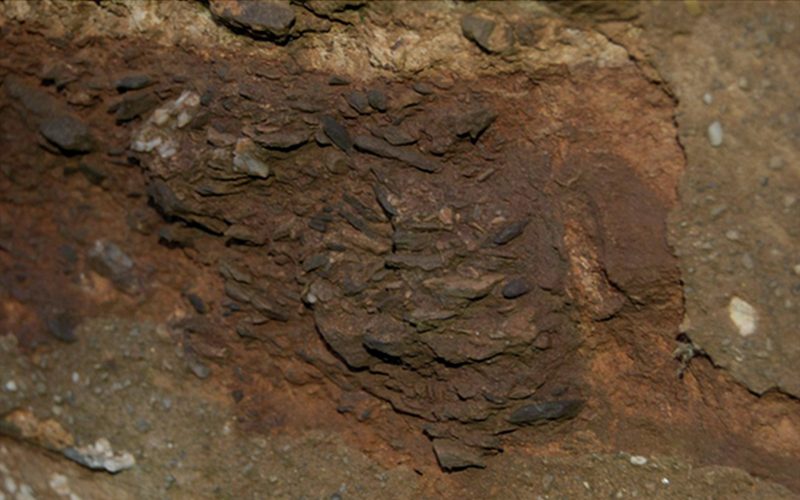
Luccombe Breccia. A classic Triassic breccia comprising sharp angular fragments of Devonian mud- and sand-stone weathered off bare local hills by thermal action. The red colouration is iron oxide. The fragments are cemented together by a mixture of iron oxide and silica.
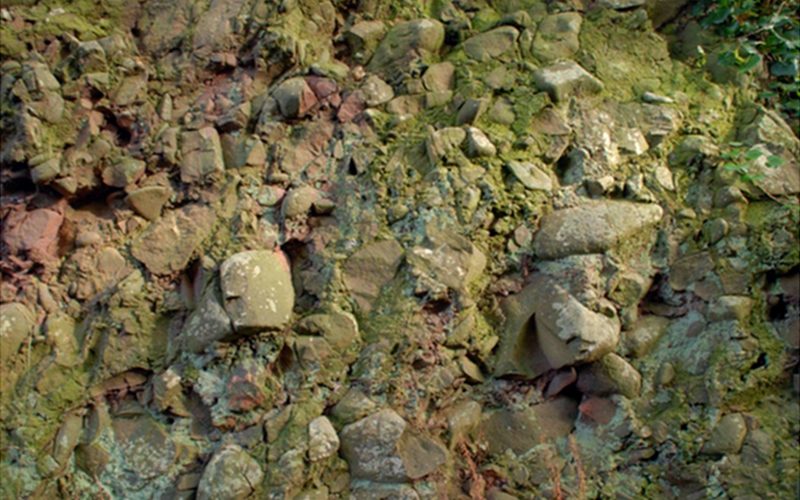
Another bed within the Luccombe Breccia is this boulder bed, a coarse conglomerate of generally large water-rounded rocks. This is suggestive of periodic flash floods tumbling these great lumps along and dumping them in seasonal watercourses which dry out and bake between floods.
Further Reading
A longer version of this article can be found online here: https://ougs.org/southwest/local-geology/58/permo-triassic-breccias-in-devon-and-somerset/
For those interested in the geology of the area the author recommends:
‘Exmoor Geology’ by R A Edwards published by Exmoor Books in 2000. ISBN 0 86183 411 9
AN Thomas. 1940. The Triassic Rocks of North-West Somerset. Proceedings of the Geologists’ Association. Vol LI Part 1.
For those interested in the greatest mass extinction of all time the author recommends:
‘When Life Nearly Died’ by Michael Benton, published by Thames and Hudson in 2003. ISBN 0 500 05116 X
Benton MJ. 2018, Hyperthermal-driven mass extinctions: killing models during the Permian–Triassic mass extinction. Phil. Trans. R. Soc. A 376: 20170076. http://dx.doi.org/10.1098/rsta.2017.0076
About the Author
Robin Lewando has degree-level qualifications in Agricultural Science, Geology, Geography and Archaeology. He has lived most of his life in the West of England: the Isles of Scilly, South Devon, West Somerset, Mid Somerset and Sedgemoor. He has worked in agriculture, horticulture, and industry, in England, Israel, and New Zealand, and currently lives in Southern Ireland, where he is engaged in a palaeoecological study of West Cork. Robin breeds wild boar and blackface sheep on a smallholding. He has a long-time passion for Irish music, and is married to the award winning author Christine Lewando. He makes regular visits to family in Minehead, welcoming these opportunities to walk the hills and woods of Exmoor, and enjoy Sunday lunch at the Rest and Be Thankful, Wheddon Cross.
Robin’s blog is a most interesting and welcome contribution to the Luccombe website and to the knowledge about the area. It is much appreciated.