
This month’s story is all about he Lost Cottage on the Village Green…and the felonious exploits of one of its inhabitants (and her friends)
There is clear evidence that several dwellings in Luccombe were demolished in the nineteenth century, some of which have been mentioned in previous articles, particularly those at the higher end of Stoney Street and in the area now occupied by East Luccombe Farm.
For many years I have been aware of the existence of a cottage located close to the present telephone kiosk on the village green, and indeed, the National Trust’s on-line heritage map, contains the following comment:
“A cottage is shown on the 1842 Luccombe Tithe map end-on to the road just south of the phone box and car park on the east side of the road in Luccombe village. The Apportionment number is 611, house and garden, tenanted by Ann Williams. Mary Davis was living there in 1876, but by 1903 (2nd edition O.S. 1:2500 map) the cottage had gone.”
(Unfortunately the National Trust map is wildly inaccurate in pinpointing the actual location of this building; it locates it as being well to the east of Knowle Top, almost half-way to Foxhanger Linhay.)
It was not until discussing the existence of this cottage recently with another village resident, that I decided to look back through my images of that area, and much to my surprise, the cottage is ‘clearly’ visible in a view that has already appeared in an earlier “picture of the month”- it was the main illustration in February 2021, when I discussed the walnut trees in the district. The view must date from around 1882-85, because although the school had been built (in 1881), there was no fence around it.

The photograph of Luccombe that has appeared in a previous feature. The enlarged inset shows the thatched roof of the demolished cottage that I have enhanced in order to make it more obvious.
The thatched roof and the hint of first floor windows can be made out, partially obscured by vegetation. The 1841 Tithe map shows that a small garden existed on the south of the cottage, and the 25” OS map which was surveyed in 1888 shows that there was a porch or other small outbuilding on the north side, together with a modest courtyard or similar enclosed area.
In the “West Somerset Free Press” of November 9th 1872, there appeared an account of the latest Dunster Petty Sessions, held before John Halliday, James Hole and Thos. Abraham Esqrs. Under the heading “Stealing Wood”, the following case was reported:
Three women of Luccombe, named Ann Williams, Elizabeth Rowe and Ann Clatworthy, were summoned on the information of Mr Henry Randle, agent for Mr George Bryant Sully, of Bridgwater for stealing a quantity of firewood at Luccombe Wood on the 9th of September last. Williams and Rowe pleaded guilty. The case against Clatworthy was proved by P.C. Gunningham, and his evidence having been corroborated by Charlotte Staddon*, daughter of James Staddon of Luccombe, and that of Mrs. Staddon, her mother, who happened to be present in court. Mrs. Staddon said that Ann Clatworthy told her that she had thrown her rope into a neighbour’s house and that the one found in the wood could not have been hers. Cross- examined by defendant, the witness said she had said what was true. Anne Williams and Elizabeth Rowe were both examined, the latter of whom said that Ann Clatworthy was with her in the wood. (This defendant had protested that she had not been in the wood.) Mr Henry Randle proved the wood stolen by the defendant belonged to Mr. Sully of Bridgwater, and was worth 3d. Mr Randle said he did not wish to press any of the cases against the women; he only wished the public to know that until the timber had been removed, he would not allow any of it to be carried away. The bench explained the serious nature of the case to the defendants, and said that as Mr Randle did not wish to see them go to gaol they would discharge them on payment of costs, which but for the kindness of Mr Warden would have come to £2 14s. 6d. for them to pay; but the total sum amongst them now remaining to pay was £1 10s. and Ann Clatworthy having by her obstinacy, as there could be no doubt of her guilt, increased the costs in her case, the judgement of the bench was that she should pay 15s. costs, and the other two women who had pleaded guilty, 7s 6d. each. Ann Clatworthy persistently refused to pay anything, notwithstanding the offer of time to do so, and she was sentenced to 14 days’ imprisonment with hard labour.
It is highly likely that one of the defendants, Ann Williams was the same person that was living in the “Cottage on the Green” in 1842. Although not mentioned in the 1841 census, there is an Ann Williams, husband Thomas and children Charlotte, Thomas, Joanna & Elizabeth included in the 1851 returns. By 1861, only Thomas snr., Ann and Elizabeth remained.
* Charlotte Staddon was a grand-aunt of mine. She moved to London and married in 1892. Her son, Gunner Joseph Pryke, was one of the 1,269 casualties lost when the battle cruiser HMS Queen Mary was sunk during the Battle of Jutland in 1916. There were only 20 survivors.

Map of the lost cottage on Luccombe Green
The final photograph this time was taken by Bath-born photographer Robert Gillo, who established a thriving practice in Bridgwater in the early 1860s. This undated view shows the sawpit that used to be on the Green. Using a 2-man saw, the junior sawyer would stand in the pit and get covered in sawdust, while the senior operator worked above. The tower of St Mary’s Church is faintly visible above the walls of the Rectory garden. The ‘lost cottage’ was located to the left of the road, just where it disappears behind the vegetation- beyond the second walnut tree.
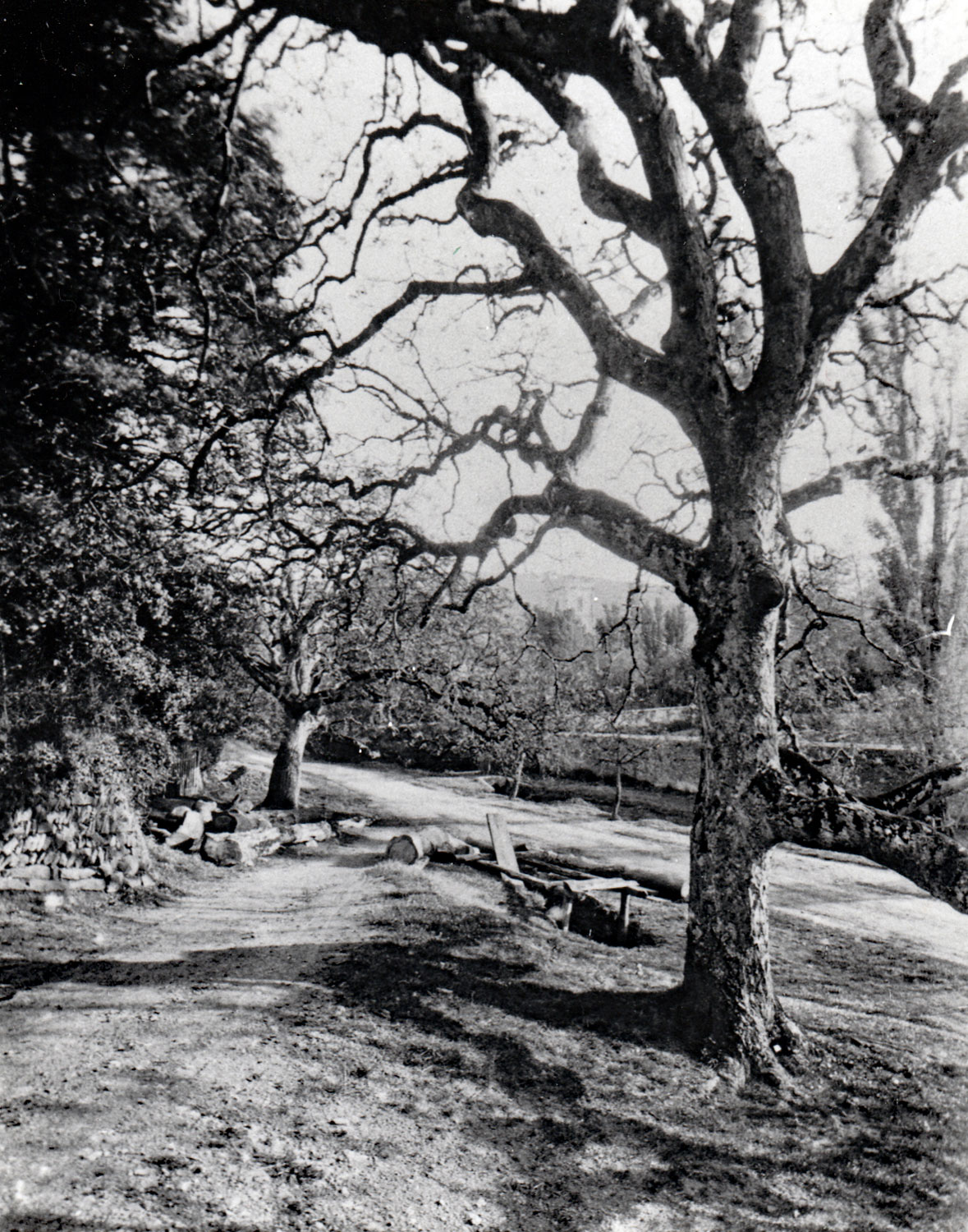
The Luccombe sawpit
Leave A Comment