
This month’s topic has been prompted by a query all the way from Melbourne, Australia regarding an image of ‘The Cottage’ near the top of Stoney Street. The questioner has sent a copy of a photograph in black and white of which she would like more information. I too have the same scene in my files, it being a photocopy of a coloured rendition that belonged to a late personal friend and ex-resident of the village who had framed it.
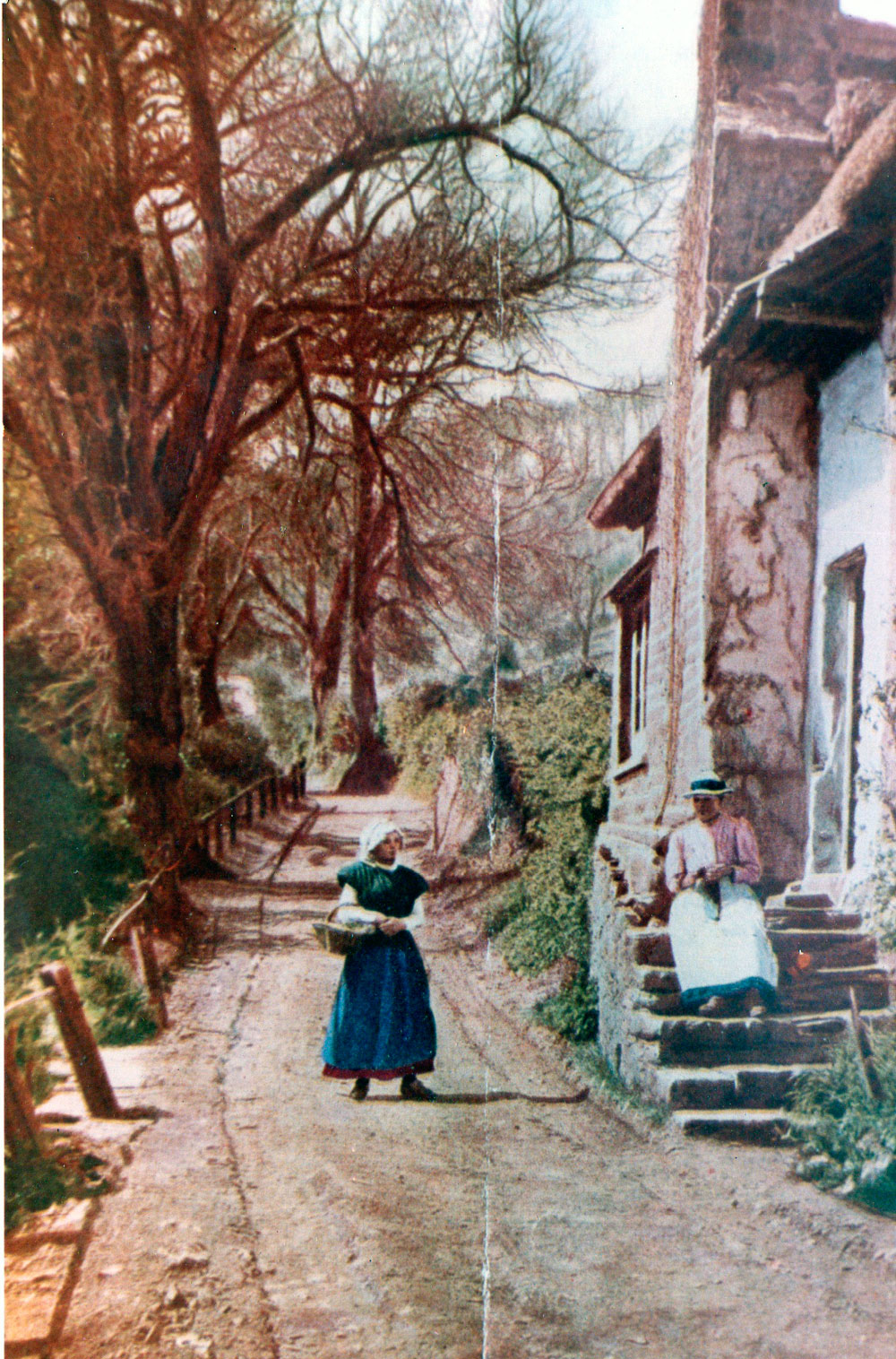
My coloured image of ‘The Cottage’
The query was directed towards discovering more about the people who lived in ‘The Cottage’ in years gone by, and this highlights a problem with the census information in villages like Luccombe, where dwellings (apart from the more important ones) were rarely named, resulting in each property being given a somewhat arbitrary index number instead of a name, which often makes it very difficult to ascertain who lived where.
Fortunately in the case of ‘The Cottage’, matters are made a little easier by the fact that Hillgate Cottages at the upper end of Stoney Street are actually named in some of the censuses. As ‘The Cottage’ is now the next dwelling down the street and assuming that the enumerator made each entry in ‘walking order’, by applying some local knowledge, it is possible to determine with some degree of accuracy the identity of some of the former inhabitants. One has to be vigilant however, as two cottages in Stoney Street disappeared between the 1840’s and 1880’s, one of which was situated between Hillgate and ‘The Cottage’
The furthest I can go back with any certainty is 1841 in which year the census showed William Gould, an agricultural labourer, his (assumed) wife, Mary and lodger Sarah Groves living somewhere in the village. The Tithe Map of that same year described plot 647 as ‘house and garden’ occupied by William Gould, and by comparing the map, its apportionments and the order of entries in the census, it is safe to conclude that they were living in ‘The Cottage’ at this period. Strangely, Isabel Richardson’s 1991 archaeological survey for the National Trust fails to detail ‘The Cottage’ at all, although she describes the site of a former house and linhay, a former stable, and the site of a former barn, all within its immediate area.
James Rew is listed as the occupier of a ‘house and garden’, plots 647 and 647a in the 1876 map of Sir Thomas Dyke Acland’s properties in Luccombe, which refers to ‘The Cottage’, and in the 1901 census he was still living there, a widower and agricultural labourer, with his son John and daughter Joan, accompanied by his son-in-law and daughter Charles and Jane Small and their son Frederick.

John and Kate Ferris with an unidentified child on the steps of The Cottage, August 1925.
The latest census results available are for 1911, when John and Kate Ferris were the occupiers, with their children James, Elizabeth, Kate, George and Thomas, their eldest son, William having already left. John’s occupation at that time was a horseman on a farm. According to earlier censuses, John was born and raised at ‘The White House’ which would be demolished sometime after 1891 and replaced with ‘Culver Cottage’. The 1871 census tells us that his father, also called John, was a ‘farmer of six acres’. Kate Ferris died in 1926 and John in 1928.
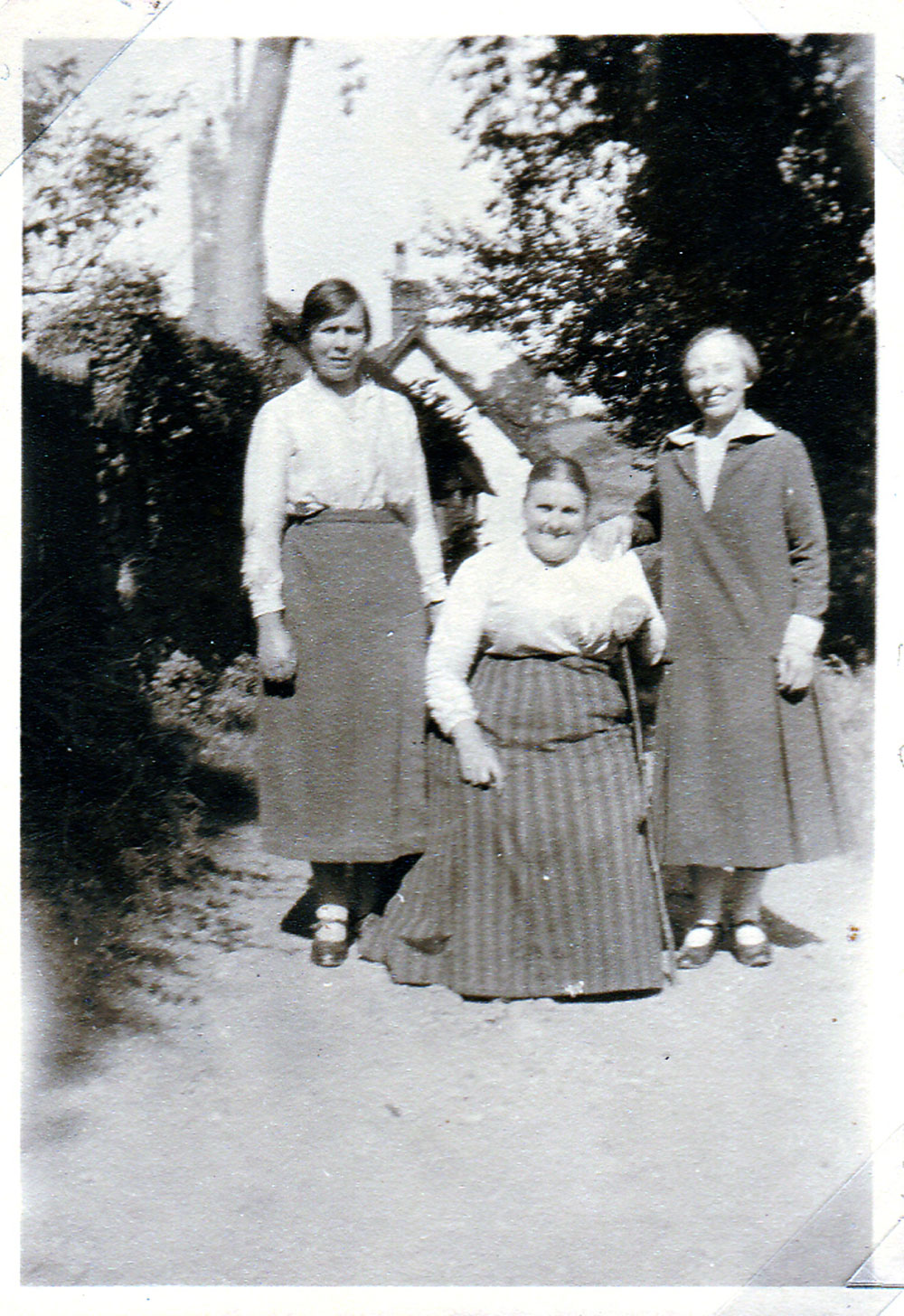
A photograph showing Mrs Kate Ferris (centre) with daughters Lizzie (left) and Katie (right) in the road between The Cottage and Hillgate.
The most recent available record is the 1939 National Register. This told us the higher Hillgate Cottage (no.37) was occupied by the Moore family, the lower Hillgate Cottage (no.36) was vacant, and the next dwelling with the generic name ‘East Luccombe’ (no.35), must be ‘The Cottage’ , and housed Robert Amber, an estate Lorry Driver, his wife Joan, daughter Jean and Clara Lincoln who carried out ‘unpaid domestic duties’. A further three entries for this address have been redacted under data protection rules.
By the time that the Mass-Observation book ‘Exmoor Village’ was published in 1947, the Gande family were in residence, because in describing the village layout after passing Hillgate Cottages, the author continued: ‘In the first house (i.e. The Cottage) lives Mrs Gande with her three children. She came from Bow in London, early in the war, and her husband has been in the Army. The children go to the Luccombe School, and the whole family have been accepted remarkably quickly by the village….’
In the same book it is written: ‘Mrs Amber’s cottage, for instance, has been condemned. During the war her husband was a lorry-driver in the Eighth Army. She has two small children and so far she has been unable to find another cottage. She thought her cottage was condemned because it was too near the water, but actually it is perched on the edge of a very steep watercourse and the authorities are afraid of a landslide’. This would suggest that the Ambers moved from ‘The Cottage’ to the lower of the Hillgate Cottages which had been vacant at the time of the 1939 register. This would explain the landslide fears. Just to put the present occupiers of Lower Hillgate at ease, extensive reinforcement of the stream banks was carried out in the 1950’s!
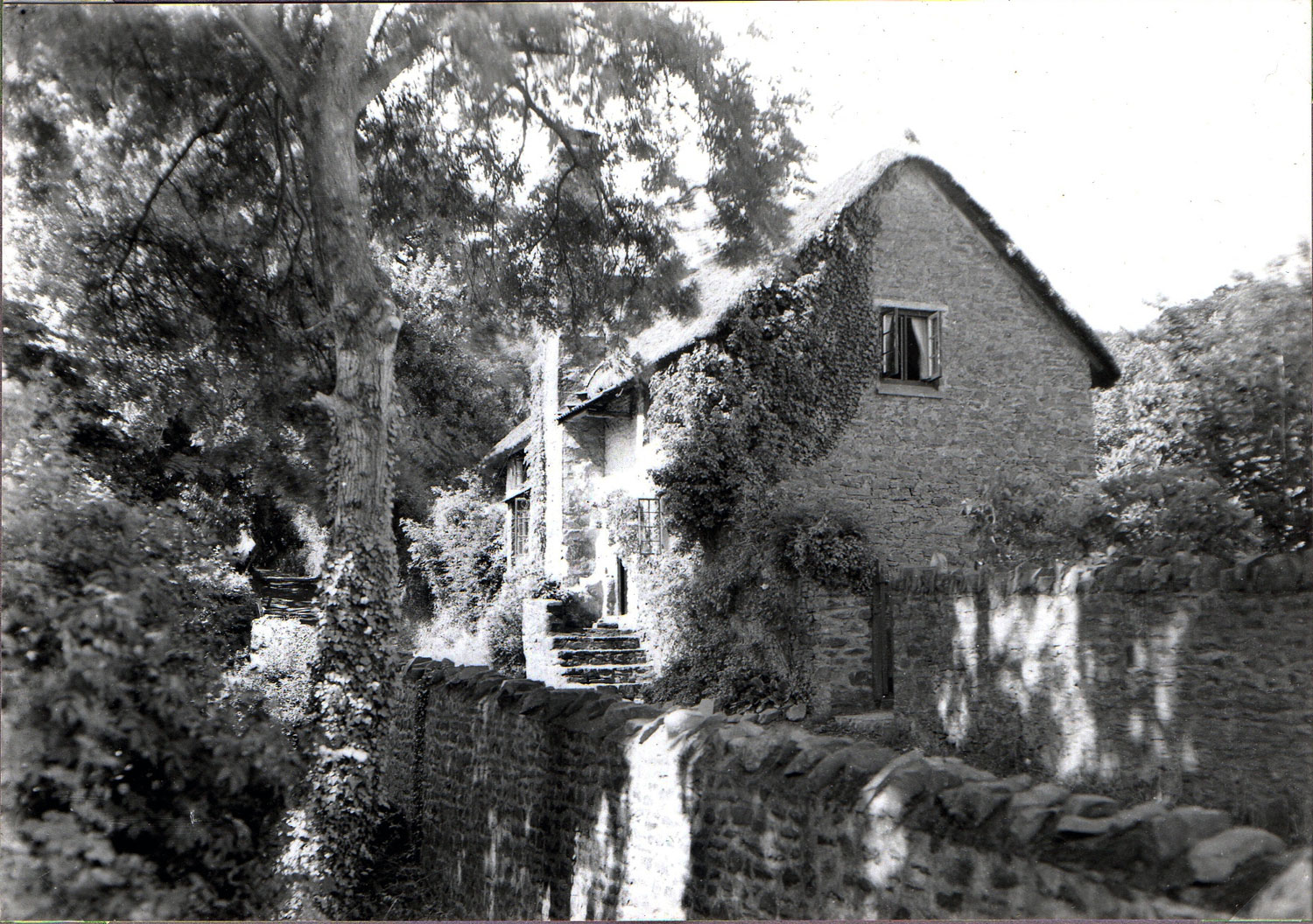
A view of ‘The Cottage’ taken either by Alfred Vowles or Kingsley Tayler.
Note: The 1939 register does contain an entry for ‘The Cottage’, but this refers to the building opposite Luccombe Knap which is now known as ‘Stables Cottage’.
I hope that the information is of some use to our Australian website visitor and that it may help her to fill in some of the gaps that I have not covered here. I have not given any more recent information, as there really isn’t any – a member of the Gande family still lives in ‘The Cottage’. Looking back at August’s picture of the month, ‘The Cottage’ is depicted as the most distant building in the Wheatley drawing.
Check out all of our previous pictures of the month and read more about Luccombe’s history
I just love these historical insights, totally fascinating. Thankyou for the information about the remedial and extensive reinforcement of the stream side at Lower Hillgate. I often look at the side garden with its steep slope and wonder what is actually holding it all up!
Thank you very much for your detailed and informative explanation. The black and white photo I have has caused a great deal of interest among the Facebook groups I belong to, and now I will be able to pass on your research to the many people who asked me about the house and its location.
Kind Regards,
Fiona Jenkins
John and Kate Ferris were my Great-great Grandparents. My Dad Ronald William Ferris, born in Newton Abbot in 1935, he was adopted by his grandparents William H Ferris and Amy Kate