
It was not until I received an e-mail and some images from ex-Holt Ball resident and enthusiastic local historian Philip Ashford, that I was reminded that 60 years ago, the whole country was in the grip of a severe winter, the West Country, especially Somerset, being particularly badly affected.
My parents often used to speak of the bad winter of 1947, coming as it did so soon after the hardships of the Second World War; this had a greater snowfall, but did not last as long, so for sheer tenacity, 1962-3 had the edge.

A gate at Holt Ball Farm. (Philip Ashford coll.)
Boxing Day 1962 was a wet, miserable day, and in the evening, my Uncle Edward, who lived at Glebe Farm (now Glebe Cottage), came up for a natter and a game of cards. When he left for home, carrying his trusty Tilley lantern, he descended the front steps, looked around, and said words to the effect of: “Oh look- it’s snowing”. That was probably the last time that we saw a snow-free road outside the cottage for over two months – the next few days saw heavy snowfall and gale-force winds, leading to severe disruption caused by deep drifts.
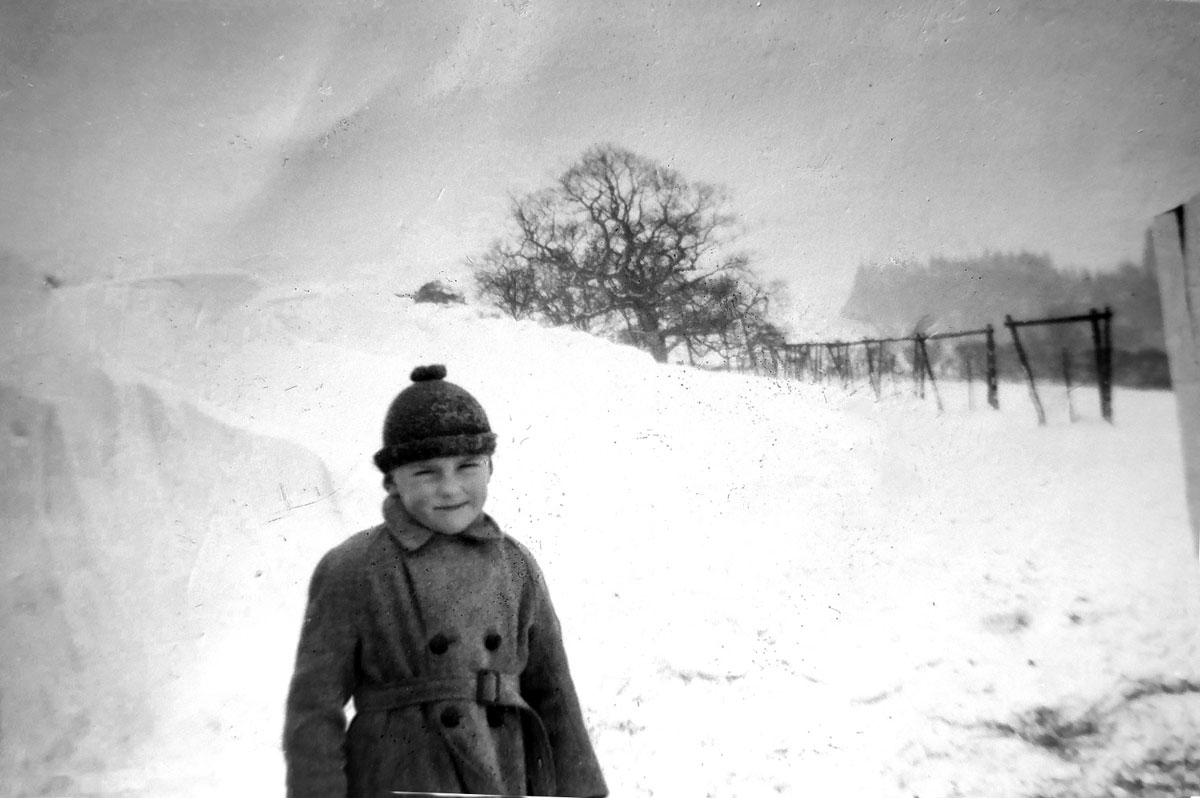
The entrance drive at Holt Ball Farm blocked by snowdrifts, with a young Philip Ashford dressed for the conditions. (Philip Ashford coll.)
In his book “Snow and Storm on Exmoor”, Jack Hurley wrote: “The east wind had been niggling like a dentist’s drill. In the late evening of Saturday, December 29th 1962, it blew a banshee note at the keyholes, cue for a whirling dance in the skies. And then the snowbag was ripped from side to side.”
“No ordinary snowfall was this, but a blinder on a bending wind, an obliterator which in sheer volume pulverised road communications. Before any recovery could be achieved, the deposit was repeated in less than a week, and again at the end of January, and the daddy of all doses descended during February’s first week.”

Wychanger Cottage.
Impressively long icicles descended from the eaves of the cottages. Streams and small waterfalls along them were transformed into spectacular sculptures of ice. Villagers had to clear pathways daily in order to access essential services (like many in Luccombe, we still had an outside lavatory). There were also regular falls of snow, with slight thawing on some days, and severe frosts at night. A partial thaw at the end of January was followed by on February 5th by a south-easterly gale and the worst snowfall of the winter, with a return to sub-zero temperatures. The change in wind direction meant that many locations previously spared the worst of the drifting now became blocked. I can remember that the cuttings in the snowdrifts at the end of Blackford Lane, leading up to the Brakeley Steps junction were particularly impressive.

A car belonging to the Witham family stranded in Wychanger Drive
Roads were partially cleared using tractor-mounted scoops and scrapers, together with manual labour, and this was a time when the road through Luccombe was on a gritting route. This was carried out when possible, by a lorry owned by George Burnell of Wootton Courtenay, who had a contract with the Williton R.D.C. The usual method was for a couple of men to be stood at the back merely throwing out the grit manually with shovels. A later high-tech method involved one man shovelling the grit into a hopper mounted at the back of the lorry, while another turned a handle that rotated the spreading mechanism.

The Holt Ball tractor, which was being driven by Bernard Dare, stopped beside the letter box in Luccombe Square, during a shopping expedition to Porlock and back, carrying Dorothy Stephenson (who lived at 2 Gilhams Cottages) in the transporter box. Wychanger Cottage is in the distance. (Philip Ashford coll.)
Saturday March 2nd saw the first indications of higher temperatures and March 6th saw the first frost-free morning in Britain, This marked the beginning of a gradual thaw, which unlike 1947 meant that there was only a little flooding.

Bernard Dare, Graham & Philip Ashford at Holt Ball Entrance Winter 1962-3.” (P Ashford coll.)
I am grateful to Philip Ashford for the use of photographs from his collection. The other photos were taken by my mother using a well-used Box Brownie camera that in its later years used to scratch the film emulsion. If you have any recollections of the Luccombe area during the winter of 1962-3, why not add them in the “comments” box at the bottom of the page?
Check out all of our previous pictures of the month and read more about Luccombe’s history
I am probably alone in wishing we still had snowy winters like those depicted! Although I would not like the energy bills. I miss the snow and the variations in the climate – those snowfalls in the early sixties were once-in-a-generation weather events.
I could do without mild wet or mild and grey weather that seems to go on indefinitely.