
Eric’s post this month is the last part in his series about Holt Ball and is primarily focused on Ronald Pitts Crick:
The concluding part of this story concentrates on the life of, and contribution to ophthalmic medicine made by Ronald Pitts Crick, the younger son of Owen Crick.
Ronald shared the same initial educational path as his older brother, Alan, however on completing his secondary education, he was awarded an Open Science Scholarship to King’s College Medical School from where he graduated in 1939. He learned to fly open cockpit planes in the University Air Squadron and served in the RNVR as surgeon- lieutenant from 1939 to 1946, mainly on the aircraft carrier Illustrious. This was a daunting experience at first, since he joined immediately after qualifying with very little actual experience in the practice of medicine, and because he was very seasick for the first 10 days after leaving port.
In 1945 Illustrious was steaming north to assist in the invasion of the Japanese islands when the atom bomb was dropped and, to the great relief of all on board – including Crick – the ship turned back for Australia.
On demobilisation in 1946, Ronald Crick started his ophthalmic training at King’s College Hospital, rising through the training grades to become consultant surgeon in 1950 at King’s, the Belgrave Hospital for Children and the Royal Eye Hospital. He delivered many lectures around the world and was awarded the Medal of Achievement by the American Society of Contemporary Ophthalmology. He wrote, with the late Roger Trimble, a Textbook of Clinical Ophthalmology in 1986 and for later editions collaborated with Professor Peng Shaw. He remained active as the president of the International Glaucoma Association (IGA) and in 2008 (at the age of 91) was awarded an honorary fellowship by the Royal College of Ophthalmologists.
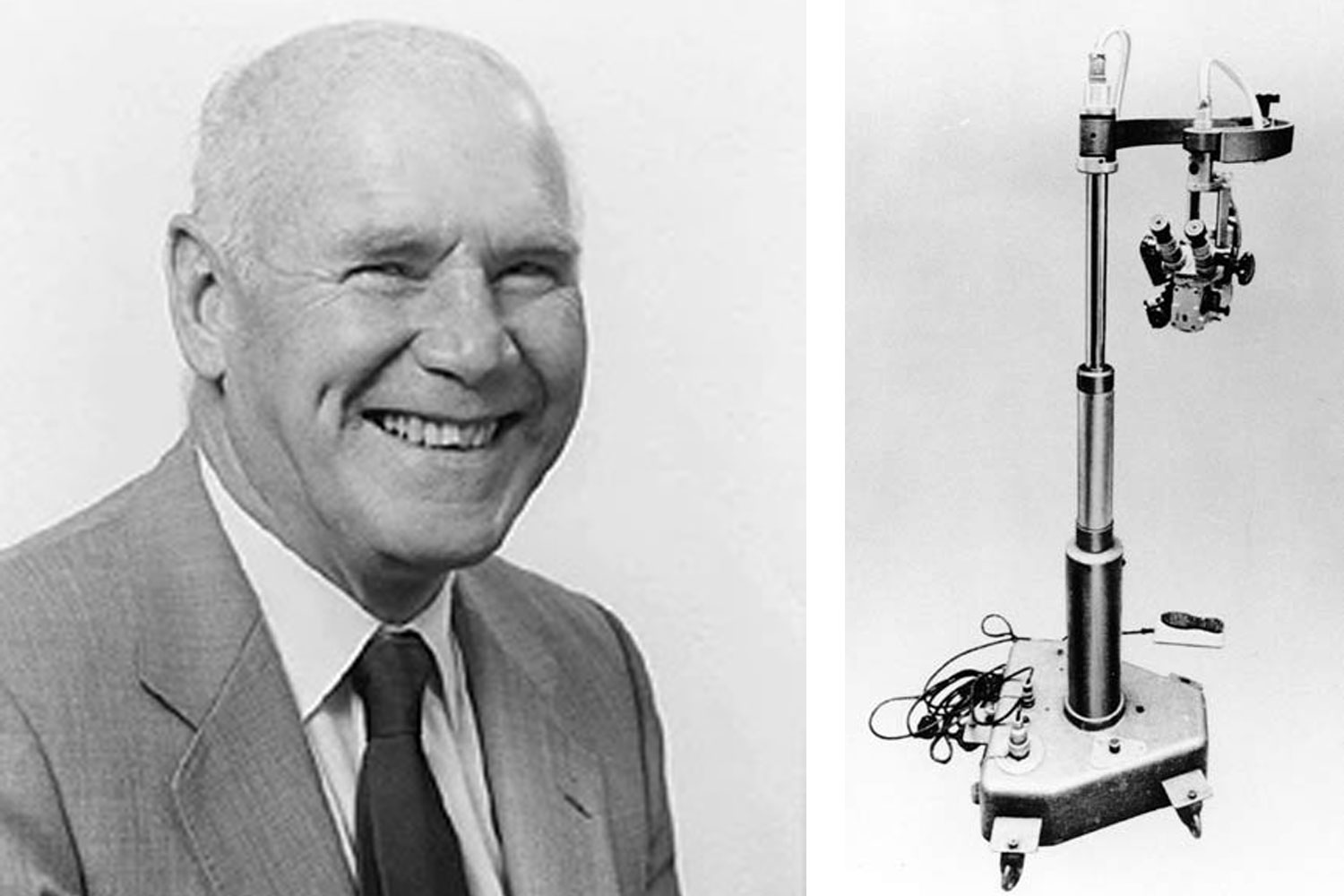
Ronald Crick and the operating microscope that he pioneered
In the 1950’s Ronald worked closely with Keeler Instruments Ltd. in developing the operating microscope for use in eye surgery and devoted much of his professional life to the study of glaucoma – raised pressure in the eye that is a leading cause of preventable blindness. At the time glaucoma was generally accepted to lead inevitably towards blindness. Crick challenged this, grasping the importance of early diagnosis. He realised this would only be possible with an extensive screening programme, quite outside the capability of the ophthalmic service. To address this, in 1974 he founded the International Glaucoma Association, a charity for increasing professional, public and patient understanding of the disease, and for funding research. The organisation has recently undergone a rebranding and is now known as Glaucoma UK. As they approach their 50th birthday, the charity has spent around £5 million researching the causes of glaucoma and finding better ways of detection. The charity was the patient representative in the development of the National Institute for Clinical Excellence guidelines for glaucoma.
Crick’s pioneering role in the development of the operating microscope, with Keeler Instruments, resulted in the first British model being shown at the 1958 Oxford Congress. Two years later a model had been developed which surgeons-in-training used at the Royal Eye Hospital. This prototype microscope was later donated to a registrar returning to India and it was still in working order in 2009.
In 1941 Ronald Crick met Jocelyn, a physiotherapist working at the Cornelia Hospital in Poole. They were engaged in 10 days and married in three months. They had four sons and one daughter. Ronald Pitts Crick died on 10 June 2009, at the age of 92. He was survived by his wife and children.
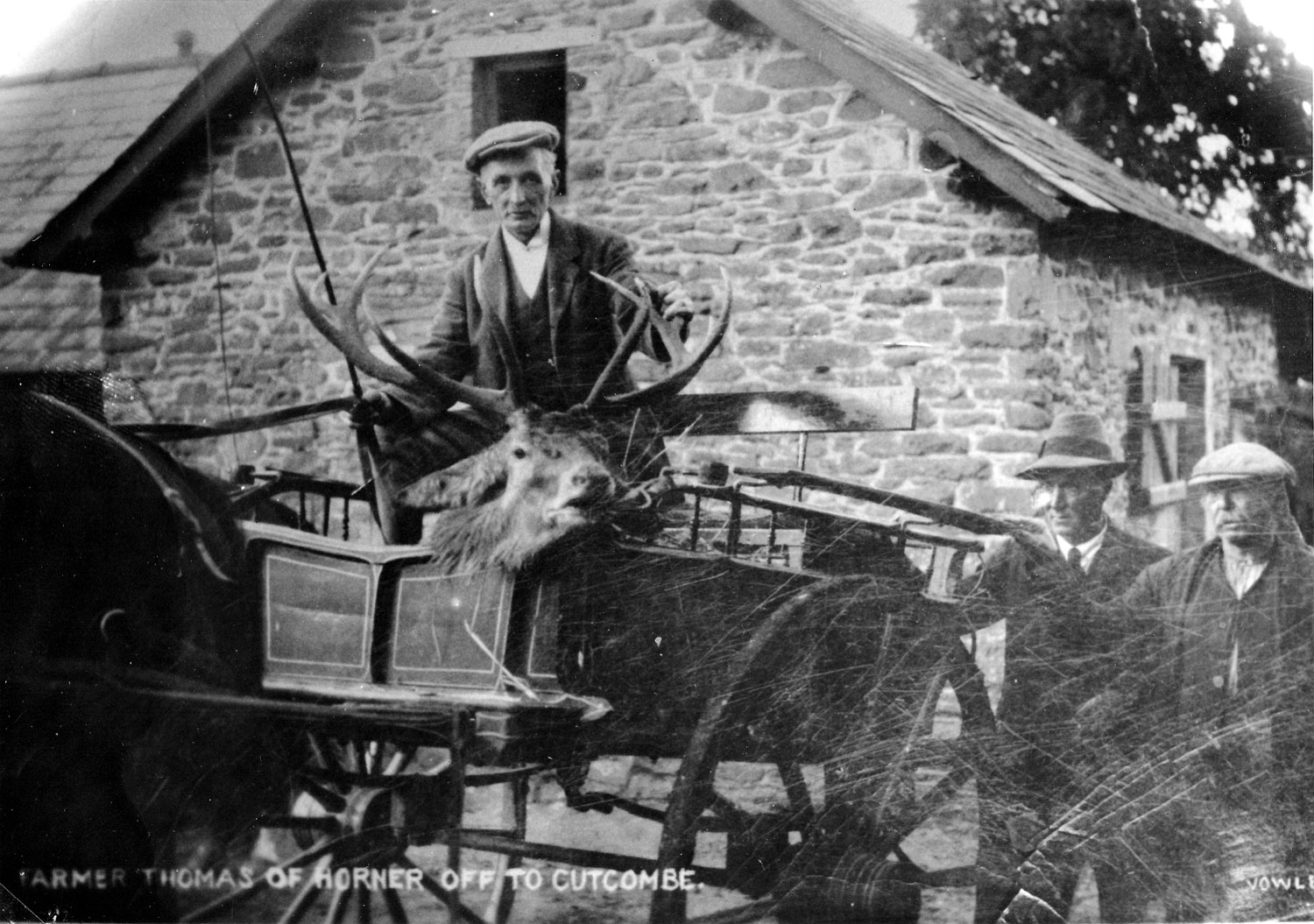
Farmer Thomas of Horner
In part one of this series on Holt Ball, I mentioned that in 1925, Mr H.J. Thomas, the son of the tenant of Horner Farm moved to Holt Ball. I do not have a photo of him, but here is one of his father. It was taken by Alfred Vowles, probably in the late 1930’s, and is titled “Farmer Thomas of Horner off to Cutcombe”. It looks very much like it was taken at Cloutsham following a successful (unfortunately not for the stag) day’s hunting. The 1939 register lists Mr Henry A. Thomas, age 63, a widower, as being the occupant of Horner Farm; also living there was the impressively named Horatio Herod, farm assistant.

Ad from West Somerset Free Press 6/11/1869
And finally this month………….
No self-respecting farmer should be without “Hawkes West of England Cattle Oils”, which this advertisement from the “West Somerset Free Press” of Saturday November 6th 1869 claims will cure any ailment from worms to broken knees.
Conveniently available from Ellis, Luccombe. (see Picture of the Month- March 2020).
See our previous stories about Holt Ball and other pictures of the month here.
Leave A Comment