Within the last month, I was delighted to have two ex-Luccombe residents call on me unexpectedly. Unfortunately the current conditions meant that the conversations were conducted at my doorstep, but nevertheless it was very enjoyable to meet with these old acquaintances again.
My first visitor had close connections with Wychanger and spent her childhood years there at the same time that I was doing the same just down the road, and the second caller spent his childhood years at Holt Ball, and it was he, Philip Ashford, who gave me a copy of an article that he recently had published in “Somerset & Dorset Notes & Queries”, the twice–yearly journal of the Somerset and Dorset Record Societies.

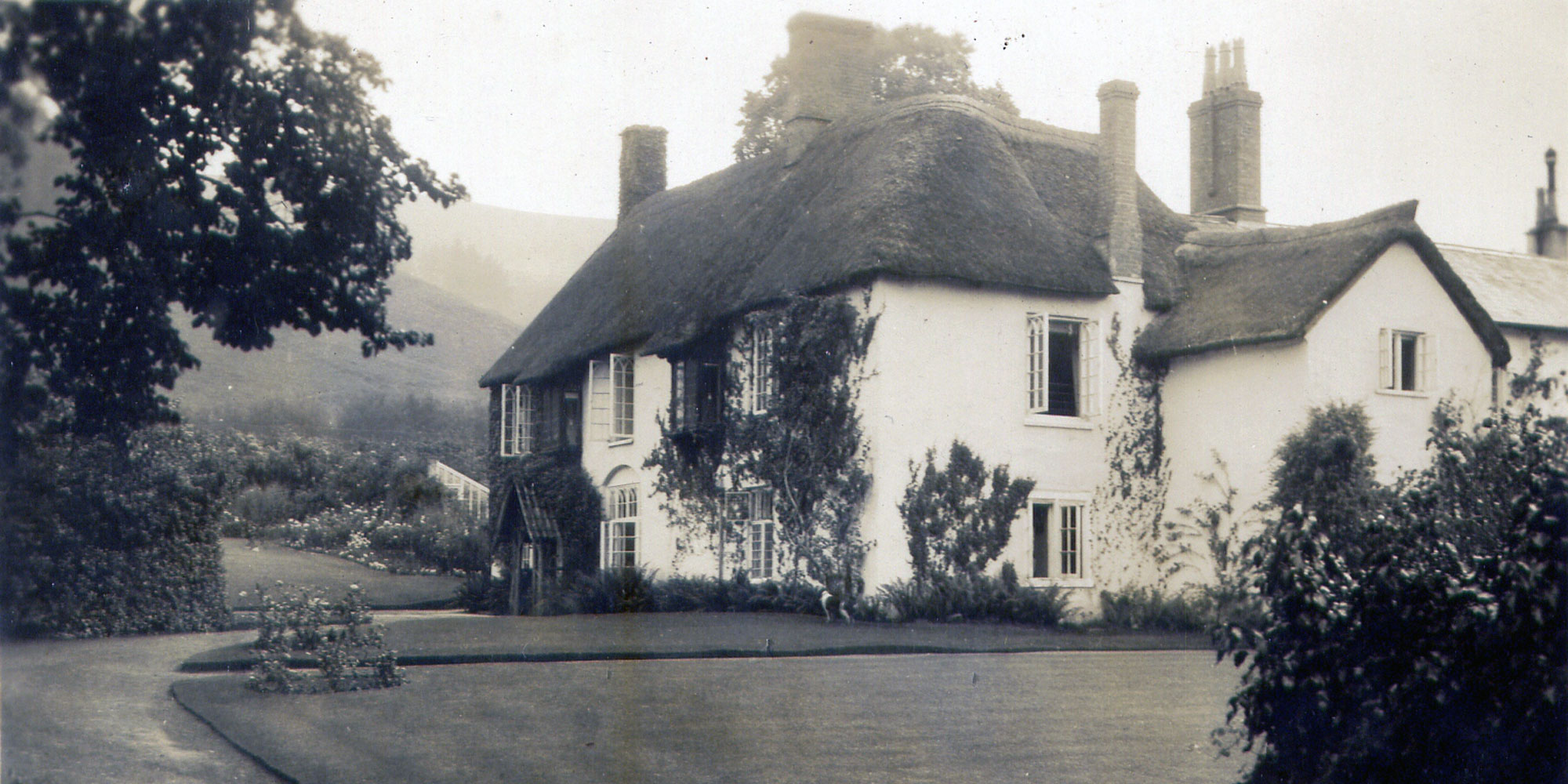
Wychanger. A picture postcard view by Alfred Vowles, probably circa 1920 as the Wychanger Plantation had been felled during WW1.
I am really out of my comfort zone with the time period covered by this piece, but it is so interesting and unusual that I will give a very brief summary of it here, and although I have no photos dating back to 1640, or showing cheese production in Luccombe, I have sneaked in a few loosely connected illustrations.
William Harrison died in late 1615, aged 76. He had followed his father, George in farming Wychanger Farm. An inventory of all his goods at Wychanger was taken in January 1616, which is now in the Harvard Law School Library.
The inventory records the contents of numerous buildings, including 14 kyne and heifers and, significantly, in the ‘Cheese Chamber’ 40 cheeses valued at 66s, one ‘Cheseracke and three shelves’ 6s, six ‘Chesevates’ 3s 6d and one ‘bearsyve with some pease’ 18d. There was a dairy house, a buttery and a larder house with numerous barrels, cheesewrings, 12 more cheese vats and three milking pails. There was also 14 gallons of butter, all of which could have been associated with cheese production on this substantial farm. Clearly cheese production was a significant part of the farming operation.

Luccombe (Old) Rectory – a pencil sketch taken from an original brushwork illustration made by a member of the Gould family many years before its demolition. Robert (Freke) Gould was vicar from 1782 to 1839.
Around the same time, the Byam Family occupied Luccombe Rectory. Laurence Byam was vicar from 1575 until his death in 1615. Laurence’s eldest son, Henry, was born in Luccombe in 1580, had an illustrious academic career at Oxford in the early 17th century and was recalled to Luccombe to become vicar on Laurence’s death. Recently four letters from Luccombe were unearthed, written by Henry Byam between 19 January 1639/40 and 27 April 1640 that mention some enormous cheeses that had been made on his farm in Luccombe. The cheeses were for various people. The ‘greatest and the least’, including an 82lb cheese, were meant for the Bishop of Chichester ‘the princes Tutor’ in London, the ‘middle’ cheese, 72lbs, was for the Dean of Christ Church, Oxford, and another was for his son who was also at Oxford; the son in question was Henry Byam junior, Henry senior’s eldest son, who was also at Christ Church Oxford.

Left: Henry Byam. This bust in Carrera Marble is in Shire Hall, Taunton. Right: William Harrison (a woodcut of the Memorial Brass in the floor of Luccombe Church).
By necessity this is only a snippet of Philip’s original article. He goes on to describe further transactions involving local cheese and the logistics involved in such an undertaking. It is clear that cheese production formed a major portion of Luccombe’s economy during the first half of the 17th century. The complete article, Luccombe Farmers and Cheese Producers 1615-1640, can be read in “Somerset and Dorset Notes and Queries” Sept 2020.

Luccombe (New) Rectory. A picture postcard view by Alfred Vowles.
Check out all of our previous pictures of the month and read more about Luccombe’s history.

Fascinating article – thank you. Where was the ‘Old Rectory’ in Luccombe?
Thanks for your interest Peter. I have just finished December’s pic of the month in which I conclude that the New Rectory was probably built on, or very close to the site of the Old Rectory. I was also pleased to see that your efforts in repainting our telephone kiosk was not wasted!