
I was recently scanning a fragile cutting from a regional newspaper that had been given to me by an elderly Luccombe resident in the 1990s. Although there was no date on it, she had written ‘1960’ in the margin.
The article was probably one in a series, as it was headed “This is Your Village”, although the dominant title was: “You Feel Cut Off in the Closed Vale”. The author had obviously visited Luccombe and in addition to describing the village he went on to point out some of its shortcomings, and interviewed three residents.

Cllr Philip Greig of Wychanger Barton and Mr William Glasow, shoemaker, who lived in Post Cottage with his wife, Sarah
In the opening lines, he commented:
“With Dunkery Beacon towering sombrely 1,700 feet above, the hamlet of Luccombe nestles in the foothills of Exmoor, two miles off the main road between Minehead and Porlock. It has much to offer the tourist in search of beauty and solitude.
“Yet it is less well known, because of its relative inaccessibility, than its picture – postcard neighbours, Allerford, Selworthy and Wootton Courtenay,
“The 20-odd cottages that line its two narrow, winding streets seem to be protected by the large houses scattered around the hamlet and the whole aspect of the place is dominated by the village church of St. Mary.
“The name Luccombe means Closed Vale, and is an apt description of the place, for in Luccombe one seems to be cut off entirely from the outside world, despite the fact that the seaside resort of Minehead is only four-and-a-half miles away.
“In this tiny hamlet there is one shop-cum-post office, no public house, one bus a week during nine months of the year – one a day during the summer season, no flush sanitation, no playing field and no school. Luccombe also is without a resident parish priest. But for all this lack of facilities, Luccombe appears to be an active well-knit community. The villagers do not sit still and let time pass them by.”
The first interview was with Mr. Philip Gregg [sic] of Wychanger Barton, who was the local representative on the Williton Rural District Council.
“One of the difficulties of living in a place like this is that we are so small.” He said.
“The population is about 150, with 133 people on the electoral register. The villagers hold together to a certain extent and there are a number of village activities and functions.
“All this is carried on even though the Village Hall is a leaky and dilapidated building and urgently needs replacing. A new hall would be a great help to the villagers, cut off so much from the amenities of Minehead.
“The main problem is to find ground on which to build one. Most of the place is owned by the National Trust and we also come under the Exmoor National Park Commission. Sanction from them has to be obtained for all new building here.”
Luccombe lacks village soccer and cricket teams. There are two main reasons for this. Firstly there is no village playing field. Second: The population of the place is too small to support such ventures. The lack of a playing field is not serious in a hamlet such as Luccombe, for the streets are free from traffic and small children can play there in almost complete safety.
But Luccombe is not without its problems, despite being untouched by modernisation. In fact it is this is this that has led to problems of an essentially modern nature. The main difficulty in the village is lack of a mains water supply. Electricity has been at Luccombe for some time, but; electricity did not mean the advent of mains water.
“However,” Mr Greig said, “We hope that they will be putting us on to mains water supply shortly and then we shall get flush sanitation in the cottages and houses. At the moment most people have earth closets.”
Another problem is that of flooding. Last winter most of the village was badly flooded by an excess of water coming down from the Moor.
“The National Trust have started flood prevention schemes here and work is going on at the moment. This Winter the floods were so bad that they washed out part of the churchyard wall in Stoney Street and that is also being repaired now” said Mr. Greig.
Further difficulties are raised for the villagers by the lack of public transport. Most of the villagers are agricultural or forestry workers and few possess motor vehicles.
Mr. Greig told me: “We get one bus a week, on Saturdays, during the winter. There is one a day during the summer season from June to September.”
Mr. Greig is also a churchwarden at St. Mary‘s and he told me that the church in the village was fairly strong. A lot of people come to the church from outside the village. The rector of the parish lives at Wootton Courtenay and St. Mary’s is run mainly by Dean Thickness [sic], formerly Dean at St. Albans.
“Luccombe does have quite a lot of visitors in the summer, mostly coach parties and hikers from Exmoor”, said Mr. Greig.
But he said before I left: “It’s a delightful spot in which to live, but very much a backwater.”
The person who has lived longer in Luccombe than anybody else is the senior bell-ringer at the church, Mr. Frank Tame, who was born in Luccombe some 73 years ago and has lived there all his life, for most of the time in his little cottage in Stoney Street.
“The place has hardly changed at all,” he said. “Only four houses have been built here in all the time that I’ve been in the village,” (These would have been 1 & 2 East View, Orchard Close, and Three Gates)
“There used to be a school at Luccombe but it was closed after the retirement of the headmistress after the last war. I don’t think that it paid to keep a teacher there because there are so few children in the village. Some of the children go to Timberscombe and some to the Secondary Modern School at Alcombe, and one to Minehead Grammar School.”
Luccombe, small as it is, is not short of craftsmen. There is a thatcher and his apprentice in the village and a skilled shoemaker. I met Mr. William Glasow, the shoemaker, at his cottage in Stoney Street.
He said: “I make all my shoes by hand, partly for myself and partly for a firm in Bristol. I learned my craft at John Lobbs in London and moved down here during the war.”
He told us that his shoes cost 10 guineas a pair.
“They might seem expensive, but they last much longer than ordinary shoes, and once you’ve had a hand-made pair you never want to buy shop ones again.”
Mr. Glasow is also a parish councillor and honorary treasurer of the Parish Church Council. He is looking forward to the bi-annual fête shortly because he told me that St. Mary’s is badly in need of renovation.
“It has death watch beetle and there is a lot of work being done to restore it. The last fete raised £500 for this and we are hoping to raise more money to get it done.”
In the years closely following this article’s publication, the water supply was indeed completely modernised, albeit with pipes that would prove to have a limited life and need replacing some 60 years later. This was closely followed by major sewer installation works that radically improved domestic sanitation both within the village of Luccombe itself, and in other communities within the Vale of Porlock.
The leaking village hall soon succumbed to winter storms. Plans were initially drawn up for a new hall in 1963, which would have occupied the site of the Old Parsonage. This scheme never came to fruition, and further plans were made for it to occupy the site of the original ‘Hut’, but I seem to recall that a disagreement with the National Trust over a strip of land meant that the project was abandoned, and the old school buildings, then in use as a men’s club, were converted to become the present hall, the plans for which were submitted in 1965.
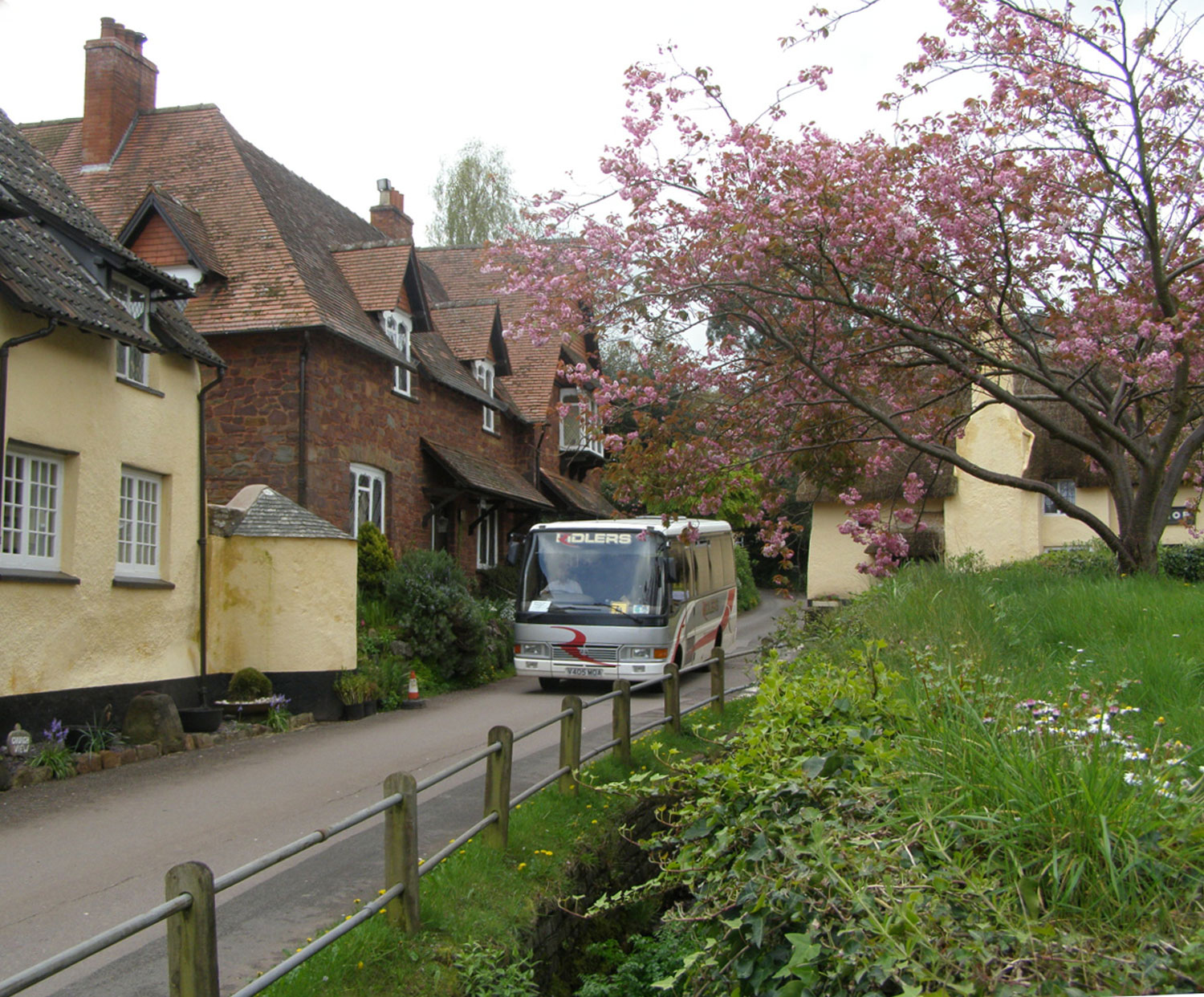
The final day of the public bus service to Minehead from Luccombe, 23rd April, 2014.
The Western National’s service bus from Minehead to Luccombe in the winter and to Luccombe and Horner Green in the summer, came to an end, but was later replaced by a thrice-weekly service that also served Wootton Courtenay. Unfortunately this was under-used, and the last scheduled service bus passed through Luccombe on 23rd April 2014.
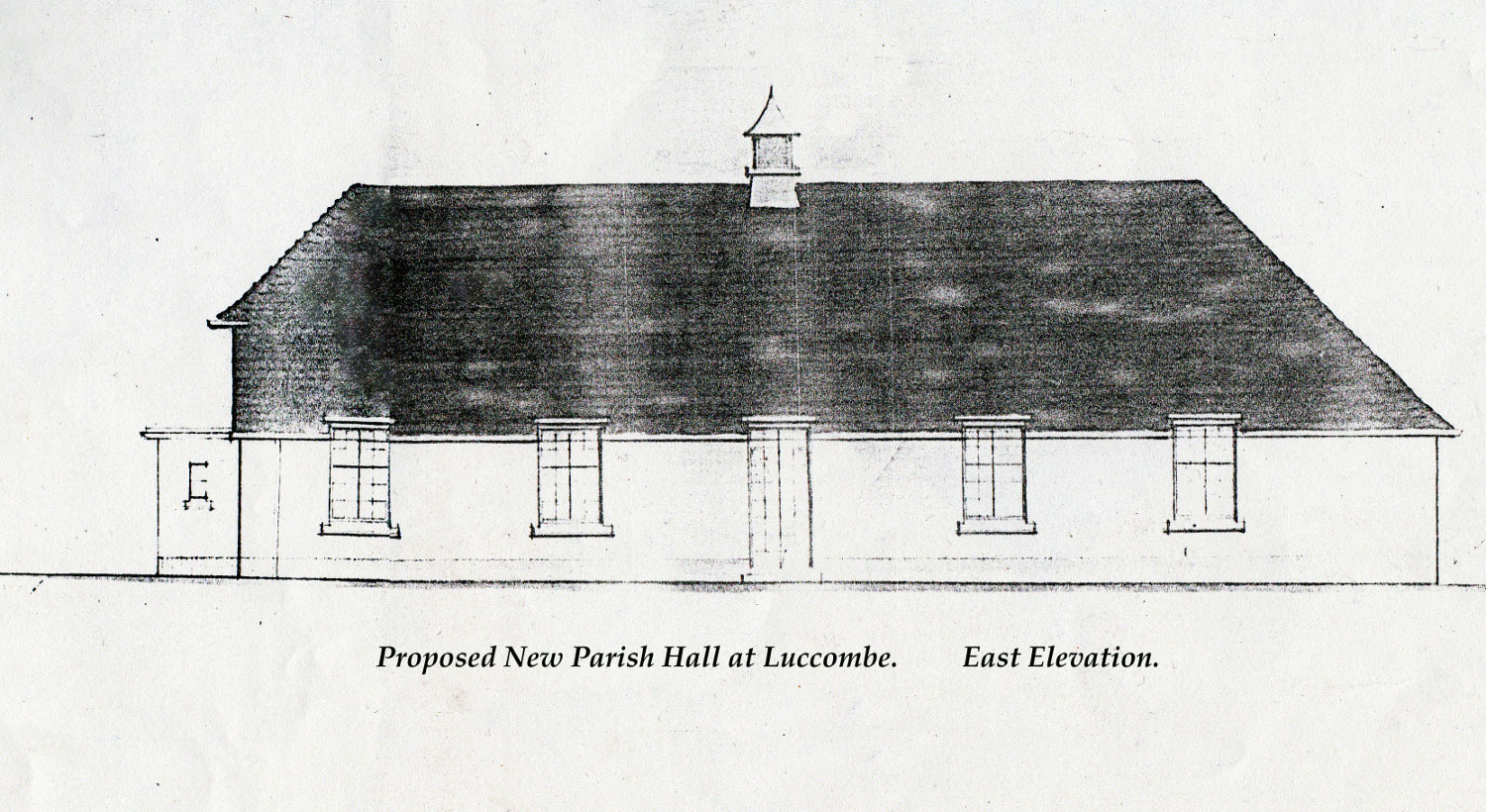
Architect’s impression of Luccombe’s proposed new village hall
The shop-cum-post office closed around 2011. A brief period as a tea-room failed to be a success and it is now a private house. A new parsonage was built circa 1969, original plans being first submitted as far back as 1952, i.e. when Luccombe Rectory was sold, but after being home to a succession of resident parish curates, the building, which was financed by a generous local benefactor, was controversially sold by the Church of England to become another private residence.
Times change, but as in 1960, Luccombe still has a “wish list”. Back then it included a decent water-supply and sanitation, a new village hall, elimination of death-watch beetle in St Mary’s Church, a resident vicar and a decent bus service. The water supply, sanitation, village hall and death watch beetle have been sorted. The bus service and resident clergy have been and gone, and the present wish list includes a useable mobile phone signal, decent broadband and a children’s play area, but to quote the final line from the 1960 article, “Luccombe proves that behind picturesqueness problems generally lie, but it is one place that is doing its best to get over them without spoiling its natural beauty.”
Next time, I may say some more about the early water supply and its severe limitations.
Check out all of our previous pictures of the month and read more about Luccombe’s history
Leave A Comment