
As the recent heatwave recedes into distant memory, it seems that on this occasion West Somerset was fortunate to be spared the ravages of the wild fires that caused so much damage in other parts of the country. This was however not the case just over twenty five years ago when the alarm was raised shortly before 2.30pm on May 2nd 1997, the Friday preceding the early May Bank Holiday weekend, after flames and smoke were spotted alongside a footpath at Woodcocks Gardens, between Luccombe and Wootton Courtenay. Within half an hour the flames had spread to nearby woodland at Luccombe Allers.

Luccombe’s main street during the fire. Emergency vehicles in abundance
Crews from Minehead, Williton, Dulverton, Bridgwater, Yeovil, Porlock, Wellington, and from Lynton and Bampton in Devon, fought the fire which was fanned by the wind and quickly spread across the moorland and into the adjoining conifer plantation, destroying between 30-40 acres of mature trees. Teams on the Brockwell side of the fire worked with chainsaws to cut firebreaks in deep gorse, those fighting it from the Luccombe end used beaters and desperately tried to maintain water jets into the dense woodland as the fire raged out of control. Their efforts were hampered by high winds which fanned the flames and at one time the fire was burning over a mile-long front and two specialist Pinzgauer six- wheel drive all-terrain vehicles were called in to help tackle the blaze. For a time, one of the fire brigade’s team was stationed on Knowle Top with a radio in order to provide long-distance updates of the fire’s progress.
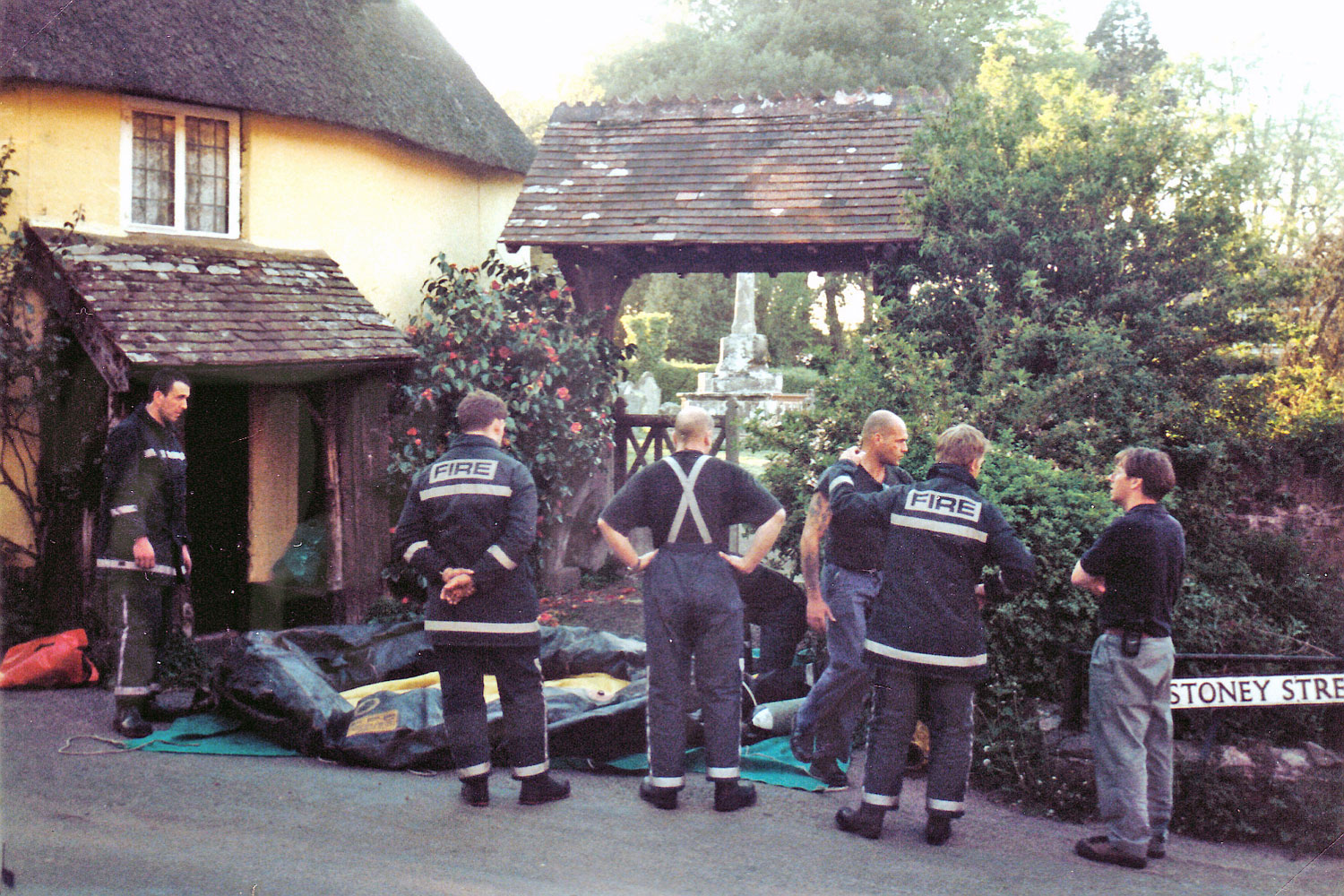
A fire crew (believed to be from Wiveliscombe) working on the inflatable reservoir by the Lych Gate. This may have been in the second phase of the outbreak
As the fire headed towards Luccombe, there were fears residents would have to be evacuated and water was sprayed on the thatched roofs of some cottages as a precaution. Additional water was ferried from the main road and it was said that even an ornamental pond was drained. An inflatable reservoir was placed in Luccombe Square and hoses ran up Stoney Street and Wychanger Drive, while the Village Hall was turned into a rest and refreshment centre for the fire crews.
Up to 200 fire-fighters battled for nearly 48 hours to extinguish the flames, eventually leaving the scene at 7am the following day but a fresh team of a further 100 officers was back two hours later after the fire broke out once again above Wychanger, and they were dampening down hot spots in the area until Sunday afternoon, when heavy rain helped cool the ground.

The water bowser from the Bridgwater station in Luccombe Square
The conflagration covered more than three square miles of moorland and woods on the National Trust’s Holnicote estate. Fire brigade investigators said the cause was unknown but National Trust Holnicote Estate countryside manager Nigel Hester said it appeared to have been started deliberately. “Certainly the reason it spread so rapidly was because of the very dry spring and the warm southerly wind on Friday.” He also added that the fire had caused massive damage to both ground nesting birds and those on the edge of the wood, as well as destroying insect populations which were a vital food supply for wildlife. Silver birch and larch trees were destroyed in the blaze and the fire also ripped through a plantation of Scots pine, planted in the 1920s.
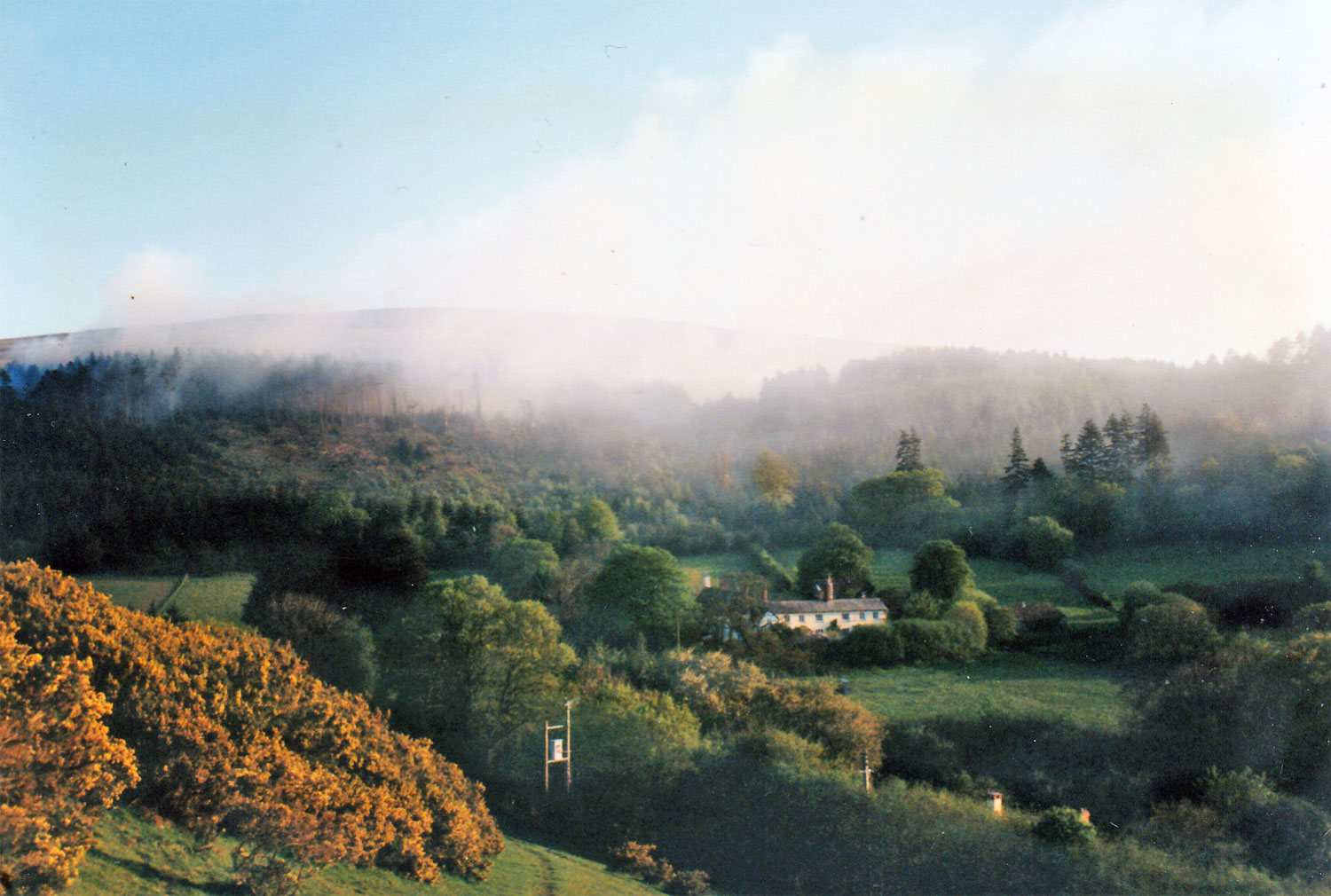
A view from Knowle Top looking towards Wychanger showing the smouldering path of the blaze and some evidence of the damage caused. The part of the village most at risk, Hillgate and the top of Stoney Street is just out of shot on the right
Following this incident and other fires on the nearby Quantock Hills, rumours spread that certain individuals had been seen acting suspiciously in these localities and that hunt followers, some of whom had threatened to start fires in retaliation for the National Trust’s decision in the previous month to ban stag-hunting on its land, were responsible. Counter-claims were made that the fires could have been the work of protestors, who were determined to blacken the reputation of hunt supporters, however no evidence was found to support these rumours, and the true cause of this dramatic event that at its height threatened several properties in Luccombe, remains a mystery.
Check out all of our previous pictures of the month and read more about Luccombe’s history
Dear Eric, Thank you so much for sharing this with the Luccombe website.
It’s very interesting history but also a reminder, in the tinder dry conditions we experienced in the most recent summer, and that are predicted to be repeated as climate change advances, that we need to be increasingly vigilant about the fire risks.
In the recent bout of hot weather, and despite large signs at the cattle grids on the approaches telling people not to have camp fires and barbeques, I discovered people barbequing at Webber’s Post!