
Eleanor Helme 1887-1967 – A Multi -Talented Resident of Luccombe.
A recent message to this website from the archivist of the Roehampton Club in SW London has prompted me to make the former Luccombe resident Eleanor Helme the subject of this “Picture of the Month”. I consider myself to be something of an Eleanor Helme ‘geek’, but I do not propose to discuss now her better-known qualities as a championship golfer, journalist, author or naturalist – I will leave that for later, but instead I will touch upon two of her less well-known achievements – as a water colour artist and as something of a pioneer of radio broadcasting.
I already had in my collection photocopies of two of her small watercolours, both of which she had presented to people that she knew well. On receiving the recent comment from the website, I decided to have another internet search, and I found myself at a YouTube video, where an antiques dealer gave a brief description of how he “researched” the artist of a recently acquired painting, except that he got it a bit wrong, despite his comments, Eleanor Helme was neither an American nor an Olympic swimmer!
A little more searching revealed the watercolour in question was for sale on an internet auction site for a very reasonable sum, and a few days later it arrived in my post box from whence it found its way to my sitting-room wall, so I am now the owner of a ‘real’ Eleanor Helme painting, pictured below – you can see a couple more of her works towards the end of this post.
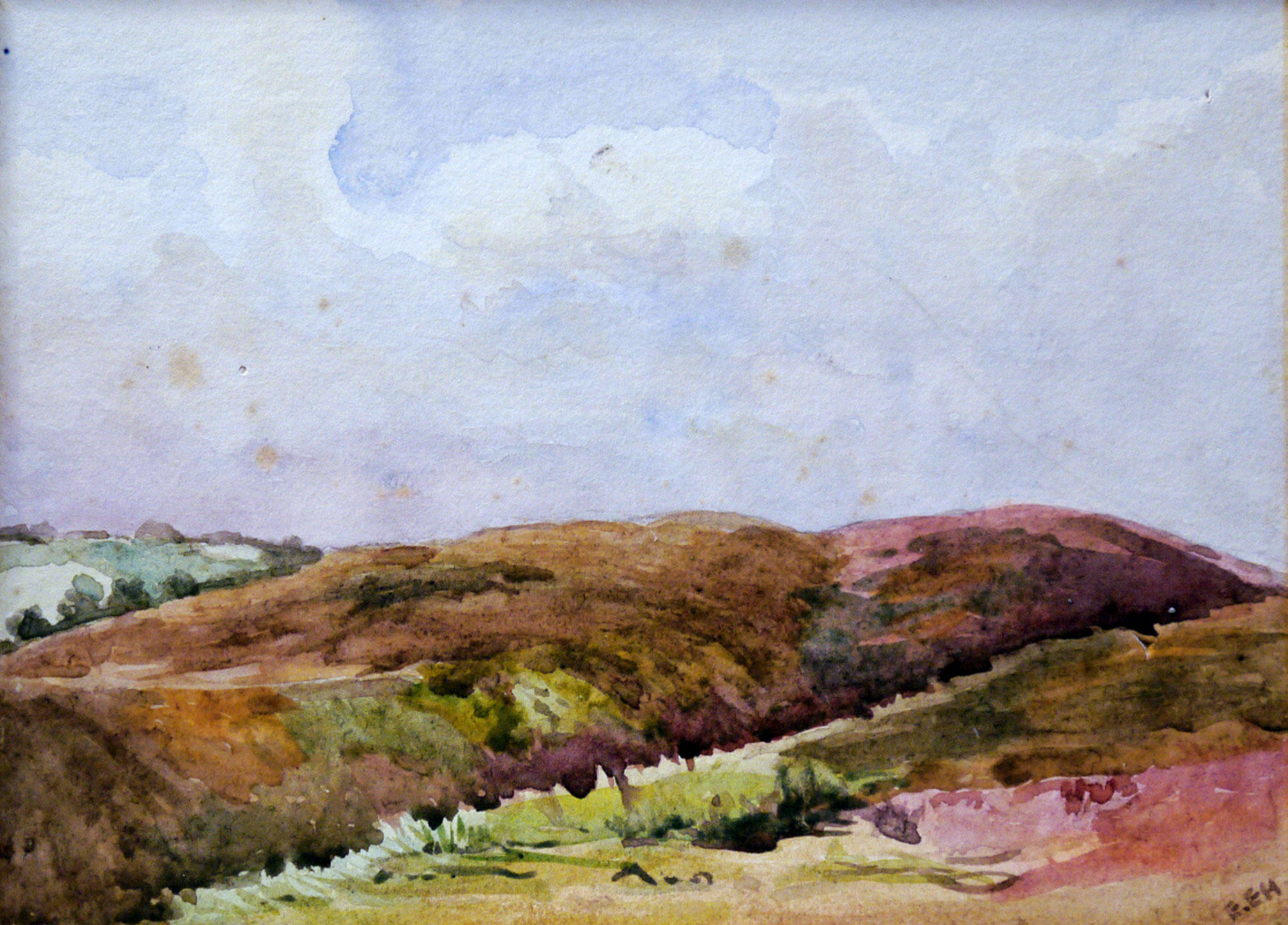
My recent acquisition: “Hanny Combe, Exmoor”, a watercolour circa 1940. Size approx. 18 x13 cm
Eleanor played golf from a young age. She first played for her county (Surrey) (see note 1, below) in 1906 and was selected for the English Ladies team in 1911. She went on to become a prolific golf journalist, and made her first radio broadcast from the BBC’s Edinburgh studio on the 19th June 1926 at 7.40pm, with a talk entitled “Ladies’ Golf”. This was transmitted to a Scottish audience via the 2EH (Edinburgh), 5SC (Glasgow), 2BD (Aberdeen) and 2DE (Dundee) transmitters. An idea of the laissez-faire nature of the situation can be gained by an account of the occasion in her book “After the Ball”:
“…… 7.15pm outside the BBC premises in George Street, Edinburgh. George Street is a solemn place, Pall Mall and St. James rolled into one: the B.B.C. was then in its youthful days (See note 2, below): I had never so much as seen a microphone. Accordingly, instead of arriving at the run as the signal went down, so to speak, behold us here assembled on the doorstep twenty minutes before time. The door is shut; futile hammerings bring no response; the solemn cobblestones of George Street echo to the flying footsteps of Miss Paul (see note 3, below) in search of a policeman to ask if this is the correct address. Return of Miss Paul and policeman.
“Och, aye. Yon’s the place a’richt. Gie it anither bit dunt (see note 4, below).”
We dunted. No result. More flying feet: Miss Paul in search of a telephone. Desperate, she enters the first doorway she sees. It is the august threshold of a club inhabited by old gentlemen. What cares she. It is now seven minutes to the fateful hour. She seizes the telephone:
“Is that the B.B.C.?” A languid reply, “Oh yes, but Miss Helme must wait, I’m alone here. I expect someone will be coming along to announce her. He’ll let her in.”
What a preparation for trying to be amusing for twenty minutes in front of that stultifying little box of tricks.”
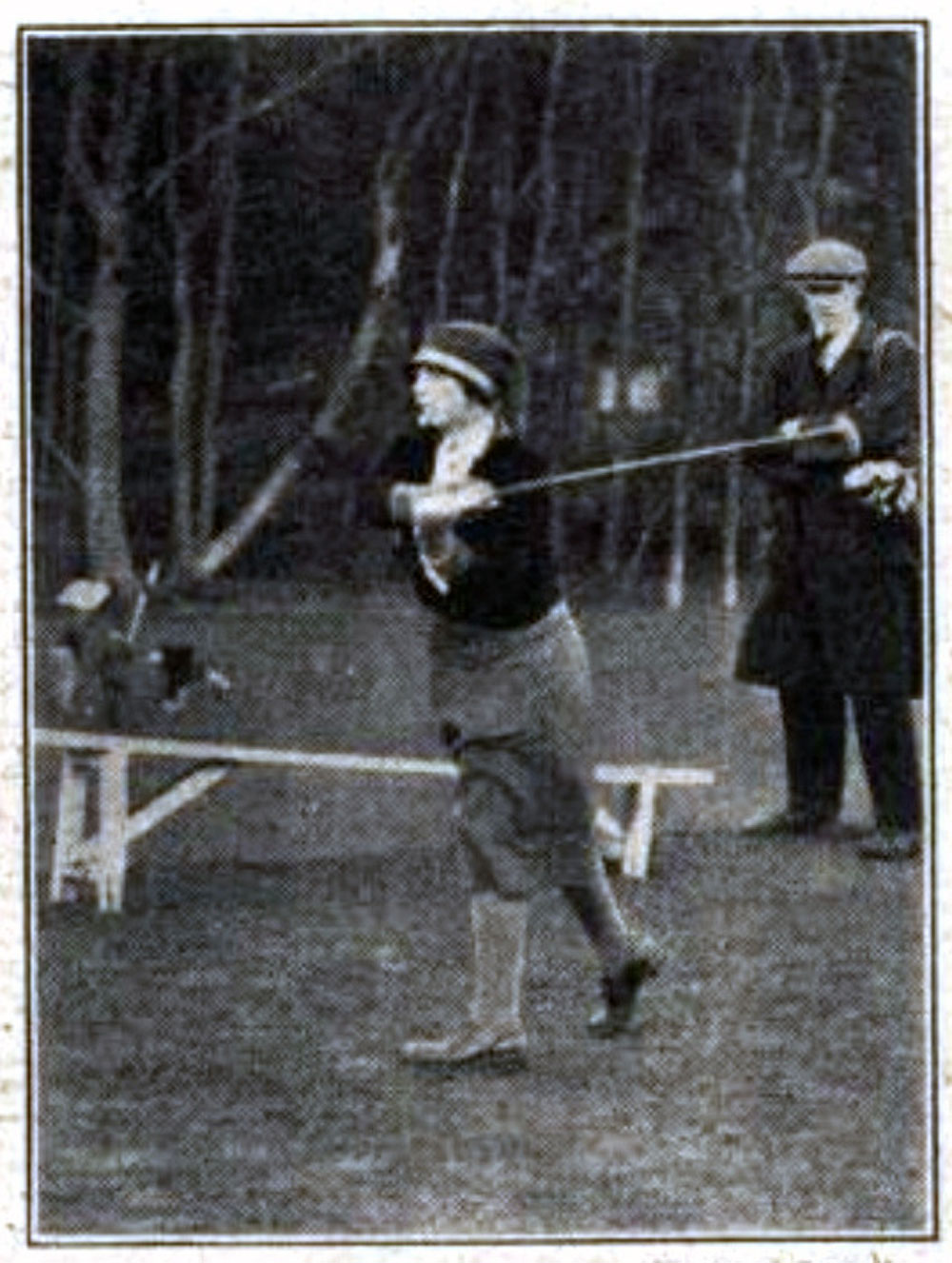
“Off the Tee – Miss Eleanor Helme who will talk from London this afternoon on ‘Women’s Golf’ is here seen in action on the Beaconsfield Links.” Radio Times, Tuesday 29th November 1927
The first live commentary of a sporting event on the BBC was an England v Wales rugby match on 15th January 1927. Other sporting events soon followed, but golf was slow to catch up, listeners having to make do with “eye-witness accounts” or summaries right up until 1937.
On the 17th of March 1927, Eleanor Helme made history by giving the first ever broadcast summary of any golf event when she reported on the Ladies’ London Foursomes final day; she was given seven minutes of air time, from 18:45 until 18:52, to tell the story. The broadcast emanated from London and was carried nationally (see note 5, below).
A dig into the “Radio Times” archives reveals that she gave at least three talks about ladies golf and contributed at least eleven “eye witness accounts” of ladies championship golf matches in her broadcasting career.

Exmoor from near Luccombe, a copy of a watercolour dated 1941, size approx. 15 x12 cm
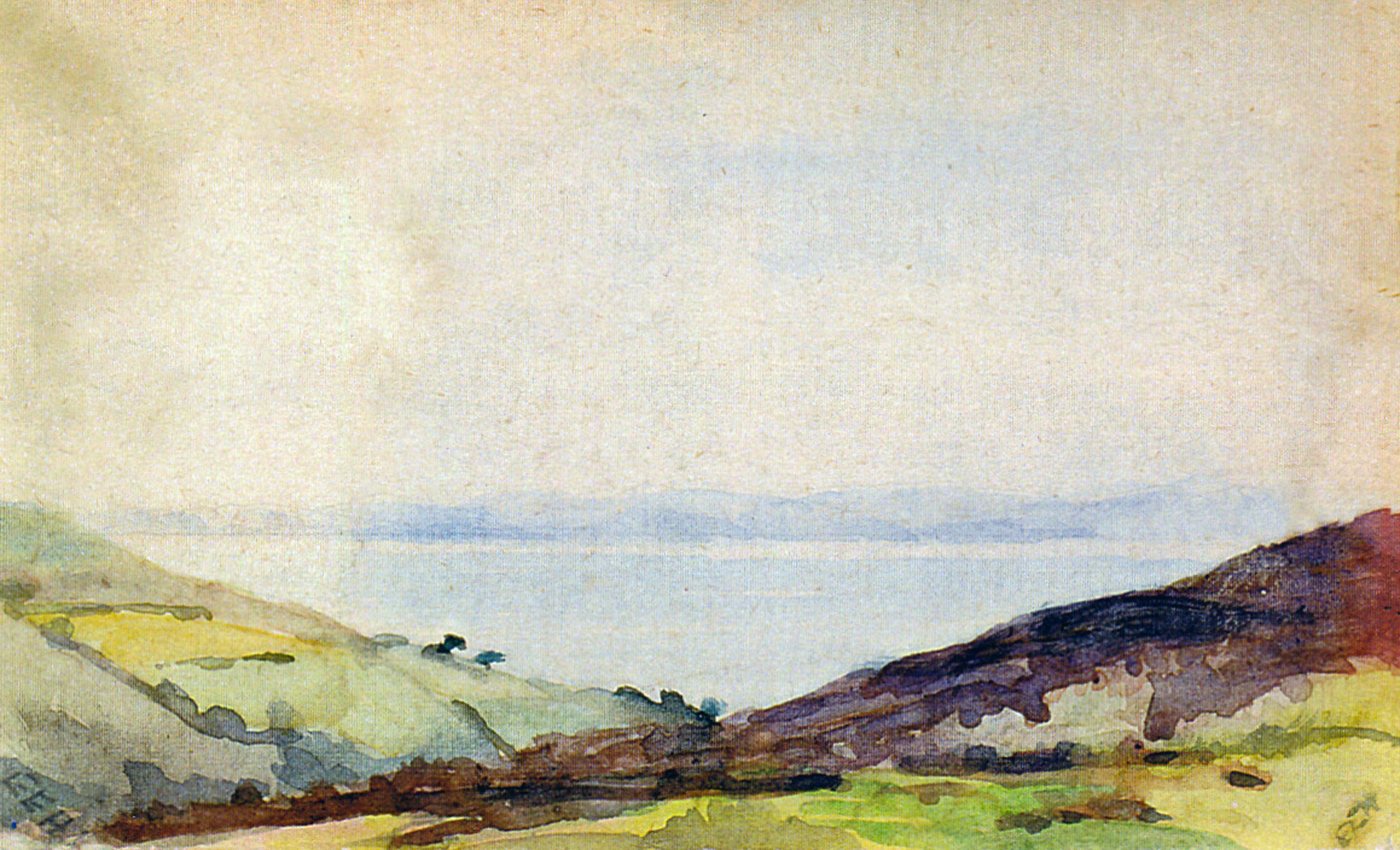
The Bristol Channel from Dunkery, a copy of a watercolour, size approx. 14 x 9 cm
Notes
1: Eleanor Helme was born in Cobham, Surrey, became a member of Leatherhead Golf Club and played to a handicap of 1. She represented England in 1911, 1912, 1913 and 1920 and won the English Ladies Amateur Championship in 1923. She was captain of Surrey Ladies County Golf Association in 1920 & 1923 and president from 1929 to 1946, at which time she would have been in the process of moving to Luccombe, where she lived with her sister, Vera, at Three Gates until 1964.
2: This would still have been the era of the British Broadcasting Company. It did not become a Corporation by Royal Charter until 1st January 1927.
3: I believe that Nance Paul was a close friend of Eleanor and collaborated with her in the writing of four of her children’s fiction books, she also appeared to have been her companion on many of her forays as a golf journalist. In “After the Ball” Eleanor comments: “……Miss Nance Paul, no less faithful than the car to aid and abet all schemes connected with notebook and pencil – not to mention a few other things.”
4: “Dunt” is Scots slang for a heavy bump or blow.
5: “Through the Green” The British Golf Collector’s Society, March 2009. – A Vision for Sound. Golf & the Golden Age of Radio Broadcasting 1923-1939. By Peter N Lewis.
Check out all of our previous pictures of the month and read more about Luccombe’s history
Leave A Comment